From Monet to Sonnet: The Story of the Three Claudes and Information Theory
The impression and the signal: three Claudes, a century and a half, and one shared question — when we communicate something, what exactly are we transmitting?
Loop engineering without the smoke: the anatomy of an autonomous loop, how I run mine with a GitHub board and subagents, and the Claude Code parts that make it possible.
forkd applies the old fork() call to whole virtual machines: a hundred isolated sandboxes in 101 ms by cloning a warm parent. The idea, explained calmly — with biology.
In mid-June 2026, a lab in Beijing released to the world — with an MIT license and open weights — a model that goes toe-to-toe with the closed frontier in long-horizon coding, at a sixth of the price. The headline isn’t the leaderboard. It’s how the thing is built. Because to read a million words…
Selling “sovereign” AI that actually runs on OpenAI’s models isn’t sovereignty — it’s a hermit crab in a borrowed shell. On the difference between armor you grew and armor with someone else’s name on the deed.
A letter from the US government forced Anthropic to switch off Fable 5 and Mythos 5 for the entire world. Seen from Europe, it’s not the dystopia — it’s the dress rehearsal. The case for European technological sovereignty.
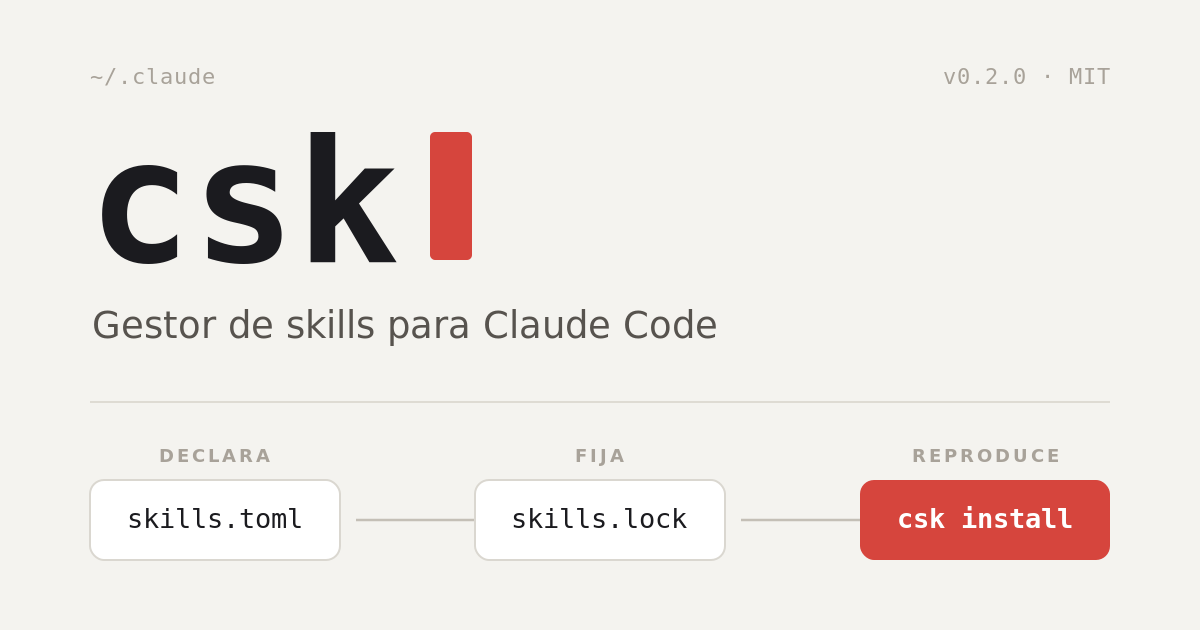
Yesterday I released csk, a skills manager for Claude Code. The recursive part: it’s built from start to finish with Claude Code. I’ll tell you what problem it solves — personal skills with no skeleton and no connective tissue — and how to try it in five minutes.