From Monet to Sonnet: The Story of the Three Claudes and Information Theory
The impression and the signal: three Claudes, a century and a half, and one shared question — when we communicate something, what exactly are we transmitting?

The impression and the signal: three Claudes, a century and a half, and one shared question — when we communicate something, what exactly are we transmitting?
Loop engineering without the smoke: the anatomy of an autonomous loop, how I run mine with a GitHub board and subagents, and the Claude Code parts that make it possible.
forkd applies the old fork() call to whole virtual machines: a hundred isolated sandboxes in 101 ms by cloning a warm parent. The idea, explained calmly — with biology.
In mid-June 2026, a lab in Beijing released to the world — with an MIT license and open weights — a model that goes toe-to-toe with the closed frontier in long-horizon coding, at a sixth of the price. The headline isn’t the leaderboard. It’s how the thing is built. Because to read a million words…
Selling “sovereign” AI that actually runs on OpenAI’s models isn’t sovereignty — it’s a hermit crab in a borrowed shell. On the difference between armor you grew and armor with someone else’s name on the deed.
A letter from the US government forced Anthropic to switch off Fable 5 and Mythos 5 for the entire world. Seen from Europe, it’s not the dystopia — it’s the dress rehearsal. The case for European technological sovereignty.
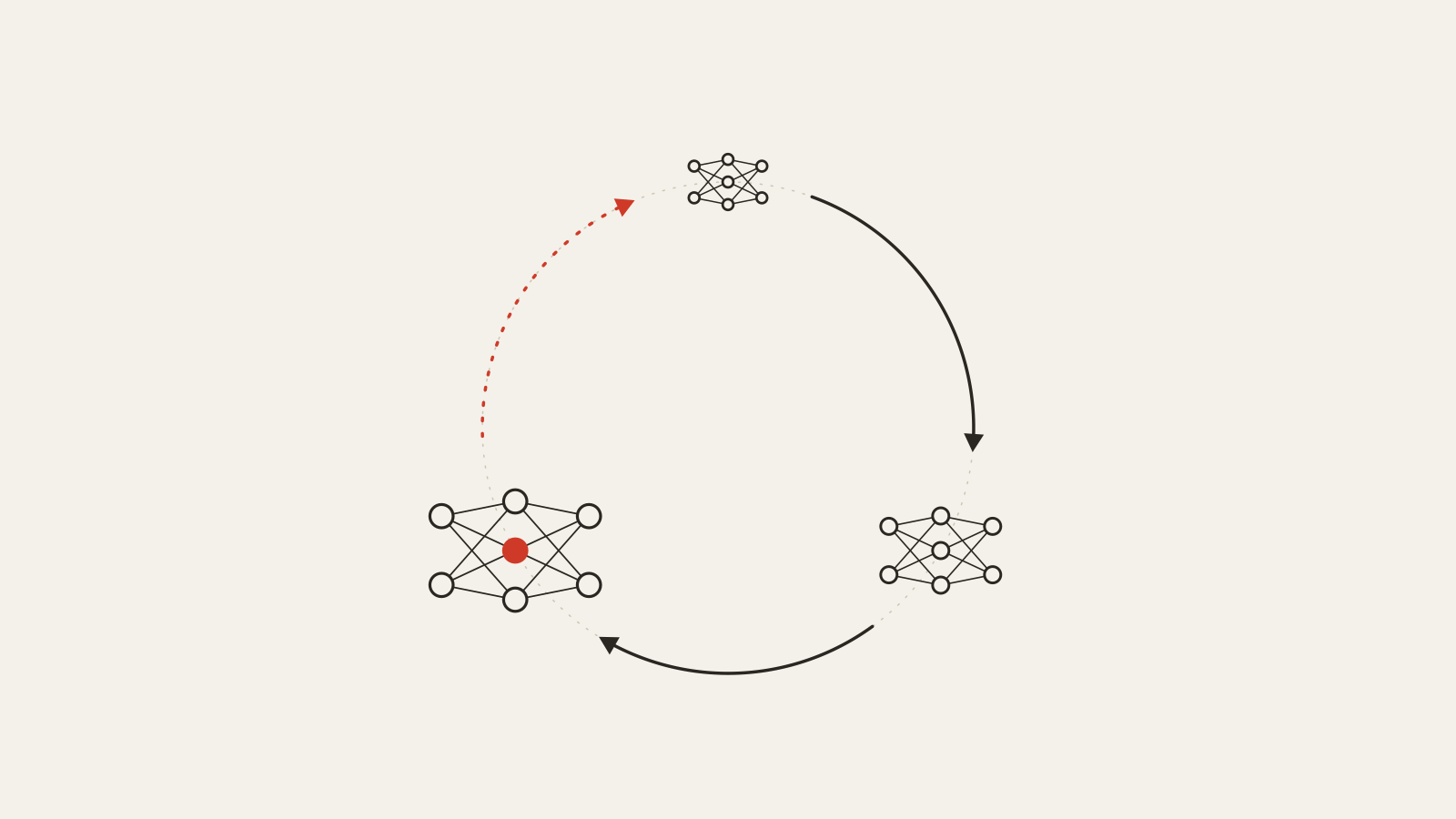
The Anthropic Institute admits its models already write most of the code used to build the next ones. A critical reading of recursive self-improvement — without swallowing the hype.
A longread on how generative AI is literally rewriting what we mean by knowledge management in a company. Spoiler: it’s no longer a repository, it’s an organism.
The human musculoskeletal system works because there’s a skeleton underneath. Modern data and AI stacks have the same problem: many muscles —Pydantic, JSON Schema, SQL, GraphQL, RDF— pulling with no bone underneath. LinkML proposes that bone.
I started out wanting a lofi session to study to and ended up with six mythological agents arguing among themselves about how to chain tracks. This is the journey of ApolloAgents from the first script in February to version 3.1, which now DJs live inside the browser.