
You have been reading “MCP 2.0” everywhere for months. Officially, it doesn’t exist: Model Context Protocol versions are dates, and the one that changed everything is 2026-07-28. Here is everything new in it, what gets lost along the way, and where FastMCP fits, because there is a naming trap and I was the first to fall into it.
Listen in my voice · 16 min
Speed:
This week I wanted to catch up on “MCP 2.0” and ended up happily reading the FastMCP 2.0 documentation. It took me a while to notice I was in the wrong place. FastMCP 2.0 is not MCP 2.0. In fact, it is the one FastMCP line that does not speak the new protocol.
So before the news, let’s untie the knot.
What MCP is, in two minutes
The Model Context Protocol (MCP) is an open standard for connecting AI applications to tools and data: your CRM, your database, your repository. Instead of writing a separate integration for every pair of model and system, the system exposes an MCP server and any compatible client (Claude, ChatGPT, an IDE or your own agent) can use it. The usual comparison is USB-C: one connector for everything.
A server offers three things: tools (actions), resources (data) and prompts (templates). Underneath, it is JSON-RPC 2.0.
Anthropic introduced it in November 2024, and since December 2025 it has been governed by the Agentic AI Foundation, under the Linux Foundation. Two years in, the figures Anthropic publishes are in another league: more than 700 million monthly SDK downloads and more than 10,000 MCP connectors for Claude.
“MCP 2.0” doesn’t exist: four names that step on each other
MCP versions carry no number. They carry a date: the last day a backwards-incompatible change went in. There have been five: 2024-11-05, 2025-03-26, 2025-06-18, 2025-11-25 and the current one, 2026-07-28.
“MCP 2.0” is the nickname the community gave that last one, because it is the largest revision since launch and it breaks compatibility. The nickname makes some sense: that same day the official Python SDK shipped its 2.0.0 release. The trouble is that it collides with a name that already existed.
| What you read | What it is | Where it stands |
|---|---|---|
| “MCP 2.0” | Nickname for the 2026-07-28 specification | Current protocol version |
| Python SDK v2 | The official library (mcp 2.0.0) | Stable since July 28, 2026 |
| FastMCP 2.0 | An independent Python framework, from April 2025 | Archived line; speaks the old protocol |
| FastMCP 4 | The same framework, August 31, 2026 | The version that does speak 2026-07-28 |
The specification doesn’t say “old” and “new” either. It uses three words worth learning: legacy (2025-11-25 and earlier, with an opening handshake), modern (2026-07-28 onwards) and dual-era (anything that speaks both).
The albatross and the ant: why MCP lost its memory on purpose
The old MCP behaved like an albatross. These birds spend years rehearsing a courtship dance before they pair up, and then return season after season to the same partner. It is beautiful and it is expensive: everything depends on that bond.
The protocol did the same. Before asking for anything, client and server greeted each other (initialize), agreed on version and capabilities, and the server handed over a session identifier (Mcp-Session-Id) that had to be shown on every request. The conversation lived in the memory of one specific machine. With ten replicas behind a load balancer, you either made each client always return to its own (sticky sessions) or you built a shared store. On serverless or at the edge, where instances are born and die all the time, that meant rowing against the current.
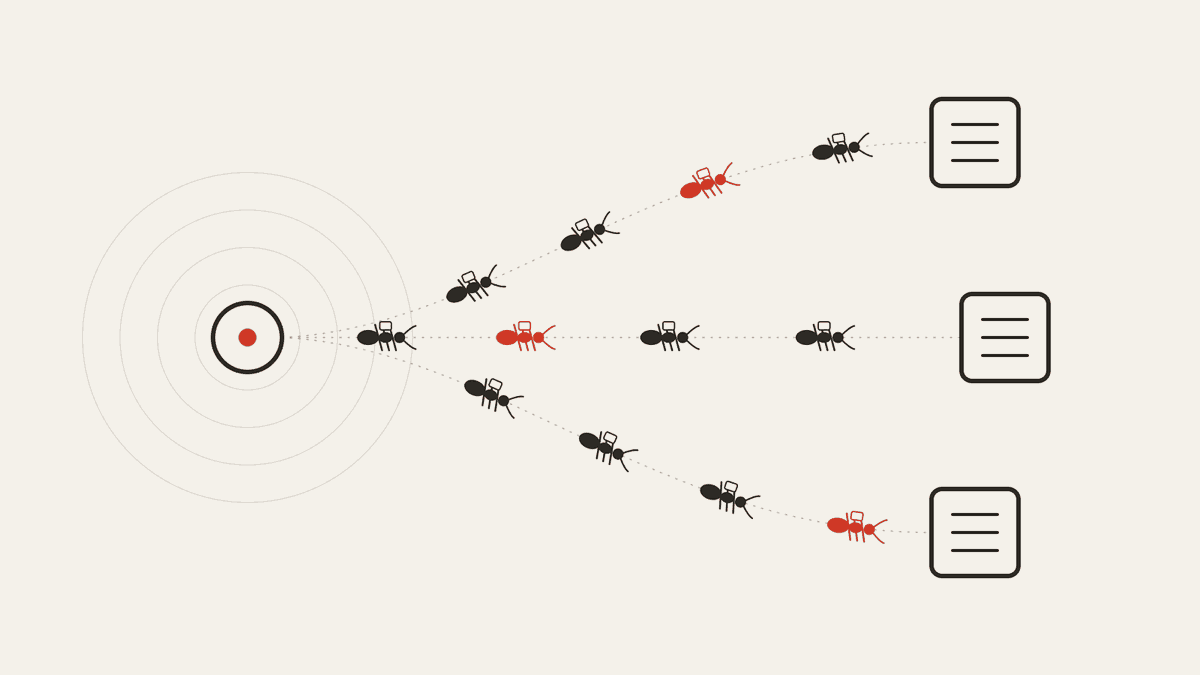
The new MCP behaves like an ant. An ant, as a rule, does not remember her nestmates one by one. She wears the colony’s identity on her skin, in a layer of hydrocarbons the others read with their antennae at every encounter. No courtship, no fixed partner: any worker can deal with any other. That is why a colony works the same with a thousand ants as with a million.
In 2026-07-28, every request carries everything the server needs. Protocol version and client capabilities are required, client identity is recommended, and it all travels in the _meta field. There is no handshake and no session. Any replica can serve any request behind an ordinary load balancer, with no shared storage.
POST /mcp HTTP/1.1
MCP-Protocol-Version: 2026-07-28
Mcp-Method: tools/call
Mcp-Name: find_order

{"jsonrpc":"2.0","id":1,"method":"tools/call",
 "params":{"name":"find_order","arguments":{"id":"P-1003"},
  "_meta":{
   "io.modelcontextprotocol/protocolVersion":"2026-07-28",
   "io.modelcontextprotocol/clientCapabilities":{},
   "io.modelcontextprotocol/clientInfo":{"name":"my-agent","version":"1.0"}}}}
One nuance that saves trouble: a stateless protocol does not force your application to be stateless. If you need to remember something between calls (a cart, a half-finished flow), the server mints its own identifier and the model passes it back as one more tool argument. State stops hiding in the transport and moves into plain sight.
Everything new in the 2026-07-28 specification
1. A stateless core and a mandatory server/discover
The initialize handshake and protocol sessions are gone. In exchange, every server must implement server/discover, which returns in one go which versions it speaks, what it can do and who it is. For the client it is optional: it can ask first or just send its request. If the version doesn’t match, it gets an error listing the supported versions and retries.
2. The server no longer calls the client: it hands the question back
Before, in the middle of a tool, the server could ask the client for something (a piece of user data, a confirmation) and wait with the connection open. That takes memory.
Now there is the Multi Round-Trip Requests (MRTR) pattern. The server answers “I’m missing this” (resultType: "input_required"), the client gathers what was asked and repeats the original call with the answers. The two calls are independent, so the second can land on a different machine. Whatever the server needs to remember travels in an opaque field, requestState, which the client returns untouched.
Along the way, every result now carries a resultType field: complete or input_required.
3. Headers to route without opening the package
Every HTTP request must carry Mcp-Method and Mcp-Name. A gateway, a rate limiter or a WAF can decide what to do with a call without reading the JSON body.
4. Responses with an expiry date
Lists of tools, resources and prompts include ttlMs (how long they stay valid) and cacheScope (whether an intermediary may share them). Servers are also advised to return the tool list in the same order every time, to get more out of the model’s prompt cache.
It is the pheromone trail: useful while fresh, then it evaporates by itself.
5. A single channel for notifications
subscriptions/listen replaces the old GET endpoint and resources/subscribe. The client picks which notifications it wants (changes to tools, prompts or resources) and receives them on one stream.
6. Stricter authorization
- The client must check who issued the authorization (the
issparameter, RFC 9207) before redeeming the code. - Credentials are bound to the authorization server that issued them and are not reused with another.
- Dynamic Client Registration (DCR) is deprecated in favour of Client ID Metadata Documents (CIMD).
7. Extensions: the protocol grows on the outside
The core stays small and the optional parts move to a formal extensions framework. Each one has its own identifier and evolves at its own pace:
- Tasks (
io.modelcontextprotocol/tasks): long-running background work. It leaves the experimental core; the client polls status withtasks/getand can supply input withtasks/update. - MCP Apps (
io.modelcontextprotocol/ui): interactive interfaces inside the conversation. - Skills over MCP (
io.modelcontextprotocol/skills): a server publishes skills (aSKILL.mdwith instructions and supporting files) next to its tools. The client discovers them withskills/list, loads them only when needed and verifies each file against its SHA-256 digest. - Enterprise-managed authorization and OAuth client credentials, for corporate environments and machine-to-machine calls.
This is no longer theory. On November 24 Anthropic switched it on in Claude and Claude Code: skills served from MCP servers in public beta, Tasks and elicitation (asking the user for input) generally available, and file uploads to MCP servers announced as coming soon. I wrote about skills, and why they need pruning, in 56,804 skills and fewer than a hundred seats.
8. Small things you will appreciate
- OpenTelemetry trace context propagated in
_meta(traceparent,tracestate,baggage). - Input and output schemas accept any JSON Schema 2020-12 keyword.
- Tidier error codes: the range from -32020 to -32099 is reserved for the specification.
What goes away: the pruning
| Before | Now |
|---|---|
initialize and Mcp-Session-Id | Metadata on every request |
| The server calls the client | MRTR: the client retries with the answer |
ping and logging/setLevel | Removed; log level is set per request |
Resuming a dropped stream (Last-Event-ID) | Removed: the request is lost and must be re-sent |
resources/subscribe and the GET endpoint | subscriptions/listen |
| Tasks inside the core (experimental) | Official extension |
| Roots, Sampling and Logging | Deprecated: they work, but don’t adopt them |
| HTTP+SSE transport | Deprecated; move to Streamable HTTP |
| Dynamic Client Registration (DCR) | Deprecated; use CIMD |
There is a process change too. For the first time there is a formal lifecycle policy: anything marked deprecated keeps working for at least twelve months before it can be removed (ninety days in exceptional cases).
The fine print: what it can cost you
So far, the brochure. Now the part that doesn’t make the headline.
- Stream resumability is gone. If the connection drops halfway through a response, the in-flight request is lost and the client has to send it again. If your tool charges a card or sends an email, a blind retry can do it twice. The transport no longer protects you: idempotency becomes your job. WorkOS’s analysis calls it the quietest change, because tests pass and the failure shows up on a real network.
- Asking the user for input changes shape. MRTR is not a tweak. It is a different control flow: where you used to wait for an answer, you now end the call and accept being called again.
requestStatepasses through the client’s hands. The specification asks you to treat it as attacker-controlled input. If it influences permissions or business logic, you must protect its integrity (HMAC or authenticated encryption) and put inside it who asked and when it expires.- Per-session catalogs disappear. Lists no longer vary per connection. If each user should see different tools, that decision moves to the authorization layer.
- The two eras don’t understand each other unaided. A modern client against a legacy server fails. A legacy client against a modern-only server fails too. The only thing that works with everything is being dual-era. The good news is that the Python SDK v2 and FastMCP 4 serve both eras from the same server.
And FastMCP? From 2.0 to 4
FastMCP is a Python framework for building MCP servers and clients with decorators. Jeremiah Lowin created it and today it lives under Prefect’s umbrella. It is neither the protocol nor the official SDK: it is a very popular layer on top, with its own numbering.
| Version | Date | What it brought | Protocol |
|---|---|---|---|
| 1.0 | December 2024 | The decorators; folded into the official Python SDK | Legacy |
| 2.0 | April 16, 2025 | Server composition, proxying, generation from OpenAPI and FastAPI | Legacy |
| 3.0 | February 18, 2026 | Redesign around components, providers and transforms | Legacy |
| 4.0 | August 31, 2026 | 2026-07-28 support: stateless, interactive tools, tasks, extensions | Modern and legacy |
Three things worth knowing:
- The 2.x line is archived. The last specification it adopted was 2025-11-25 (version 2.14.0) and its last patch dates from April 2026. Its documentation is still published under
/docs/v2/, which is exactly where I landed. - FastMCP 4 is dual-era. The server negotiates with each client: new ones get the new protocol, old ones get the old. According to Prefect, most FastMCP 3 applications upgrade without code changes.
- From 2 to 4 takes two hops. First to 3 (several constructor arguments, such as
host,portorstateless_http, move torun()), then to 4 (server-initiated sampling and roots leave the server API, and tasks move to thefastmcp-taskspackage).
In short: if your requirements.txt says fastmcp<3, your server is still an albatross. It works, but only with clients that still know the dance.
And to top off the confusion: the official Python SDK, which once absorbed FastMCP 1.0, has renamed that class to MCPServer in its version 2. And there is another FastMCP, in TypeScript, unrelated to the Python one, which according to its own README only implements the legacy revisions.
What I would do this week
- Check which era each piece lives in: clients, servers and gateways. Legacy, modern or dual-era.
- Search the code for any dependency on
Mcp-Session-Idand turn that state into identifiers that travel as arguments. - Add idempotency keys to every tool with side effects (charges, emails, sign-ups).
- Move confirmation flows to MRTR and sign the
requestState. - Return
ttlMsandcacheScope, and sendMcp-MethodandMcp-Nameso the gateway can route. - Start nothing new on Roots, Sampling, Logging or DCR.
- If you use FastMCP: plan the 2 → 3 → 4 jump instead of leaving the pin in place.
What comes next
On August 22 the maintainers published the new roadmap, with five priorities: messaging primitives for agents (server-initiated events, tasks), a single HTTP transport for local servers too, agent identity and enterprise security, better primitives (with progressive tool discovery) and a better SDK experience.
And there is now a fixed calendar: two releases a year, on the last Tuesday of March and September. The next one is dated March 30, 2027.
The third priority is the one I care about most, and it connects with what I wrote about agentic identity. In the specification announcement, Honeycomb says that nearly 20% of its monthly interactive queries already come from agents. The colony is growing.
A protocol that scales like an anthill is great news for anyone running servers. It is also a warning. When anyone can talk to any replica without introductions, the only thing separating a worker from an intruder is the passport on her skin. And in nature there are parasites that live inside the nest by copying its smell.
MCP 2.0 doesn’t exist. What exists is a protocol that traded fidelity for scale.
Ideas over codebases; evidence over hype.
Sources
- Model Context Protocol. Key Changes, 2026-07-28 specification: full list of changes, removals and deprecations.
- Model Context Protocol. Versioning and Compatibility: the terms legacy, modern and dual-era, and the compatibility matrix.
- Model Context Protocol. Multi Round-Trip Requests: how MRTR works and the security requirements for
requestState. - Soria Parra, D. and Delimarsky, D. (July 28, 2026). The 2026-07-28 Specification, MCP blog: motivation, SDKs and the Honeycomb figure.
- Soria Parra, D. and Delimarsky, D. (August 22, 2026). The New MCP Roadmap: the five priority areas.
- Delimarsky, D. and Soria Parra, D. (November 11, 2026). A More Predictable Release Cycle for MCP: six-month calendar and the March 30, 2027 date.
- Model Context Protocol. Extensions Overview and Skills: official extensions and identifiers.
- Anthropic (November 24, 2026). MCP servers can now ship skills, run tasks, and more with Claude: availability in Claude and adoption figures.
- Anthropic (July 28, 2026). Bringing MCP 2026-07-28 to Claude.
- Model Context Protocol. MCP Python SDK v2.0.0, release notes.
- FastMCP. Welcome to FastMCP 2.0, release history and upgrade guide from FastMCP 2.
- Prefect (August 31, 2026). FastMCP 4 is GA.
- WorkOS (September 16, 2026). MCP went stateless: What changed in the 2026-07-28 spec: analysis of what breaks when migrating.
- FastMCP for TypeScript README (accessed November 27, 2026).
- The albatross and ant comparisons are my own devices for explaining the change, not part of the specification.
