
In mid-June 2026, a lab in Beijing released to the world — with an MIT license and open weights — a model that goes toe-to-toe with the closed frontier in long-horizon coding, at a sixth of the price. The headline isn’t the leaderboard. It’s how the thing is built. Because to read a million words without melting down, GLM-5.2 had to learn something your brain figured out millions of years ago: ignore almost everything.
What this is, in plain English
GLM-5.2 is the flagship model from Z.ai (the former Zhipu AI), a Beijing lab with roots at Tsinghua University. It’s their third major release in the GLM-5 line in barely four months — a cadence that makes your head spin. And it isn’t trying to be a know-it-all chatbot: it’s designed, deliberately narrowly, as infrastructure for agents that write code. Implement, debug, refactor, keep an engineering task alive for hours without losing the thread.
The opening numbers are the eyebrow-raisers. Weights published openly on Hugging Face and ModelScope, under an MIT license with no regional or commercial restrictions. A context window of one million tokens. And results that — according to benchmarks published by the maker itself, a caveat worth underlining — make it the strongest open model in coding: 81.0 on Terminal-Bench 2.1, ahead of GPT-5.5 on several long-horizon tests and a single point behind Claude Opus 4.8 on others. For a model you can download for free, that’s an earthquake.
So much for the cover. Now, the red pill: let’s cut it open and look at the organs that make it run.
A brain that doesn’t switch on all the lights
First trick, the easiest to grasp. On paper, GLM-5.2 has around 753 billion parameters. Sounds like a monster you could never move. But it’s a Mixture-of-Experts model: of all those parameters, only about 40 billion fire to process each token.
Your brain does exactly that. You have around 86 billion neurons, but you don’t fire them all at once to pick up a cup of coffee — if you did, you’d have a seizure. You recruit the handful of muscles and circuits the specific task needs and leave the rest at rest. Mixture-of-Experts is that same economy: a huge roster of specialists, of which only the few that are actually needed work at any given moment. Giant’s power, a far more manageable bill.
The attention that learned not to look at everything
Here’s the jewel, and the reason that million tokens is genuinely usable and not a marketing number.
The “attention” mechanism is what lets a model relate every word to all the others in a text. The catch is that its cost grows brutally: double the length and the work quadruples. At a million tokens, making every word look at every other word is simply unfeasible. It would be like demanding the eye process every photoreceptor on the retina at maximum resolution, all the time. Nobody sees that way. You have a tiny fovea of razor sharpness and a blurry periphery that only comes into focus when something moves.
The fix is called sparse attention: instead of looking at everything, the model selects only the relevant tokens for each step. The problem is that deciding which ones are relevant — computing the index and keeping the best — also costs money, and at a million tokens it hurts again.
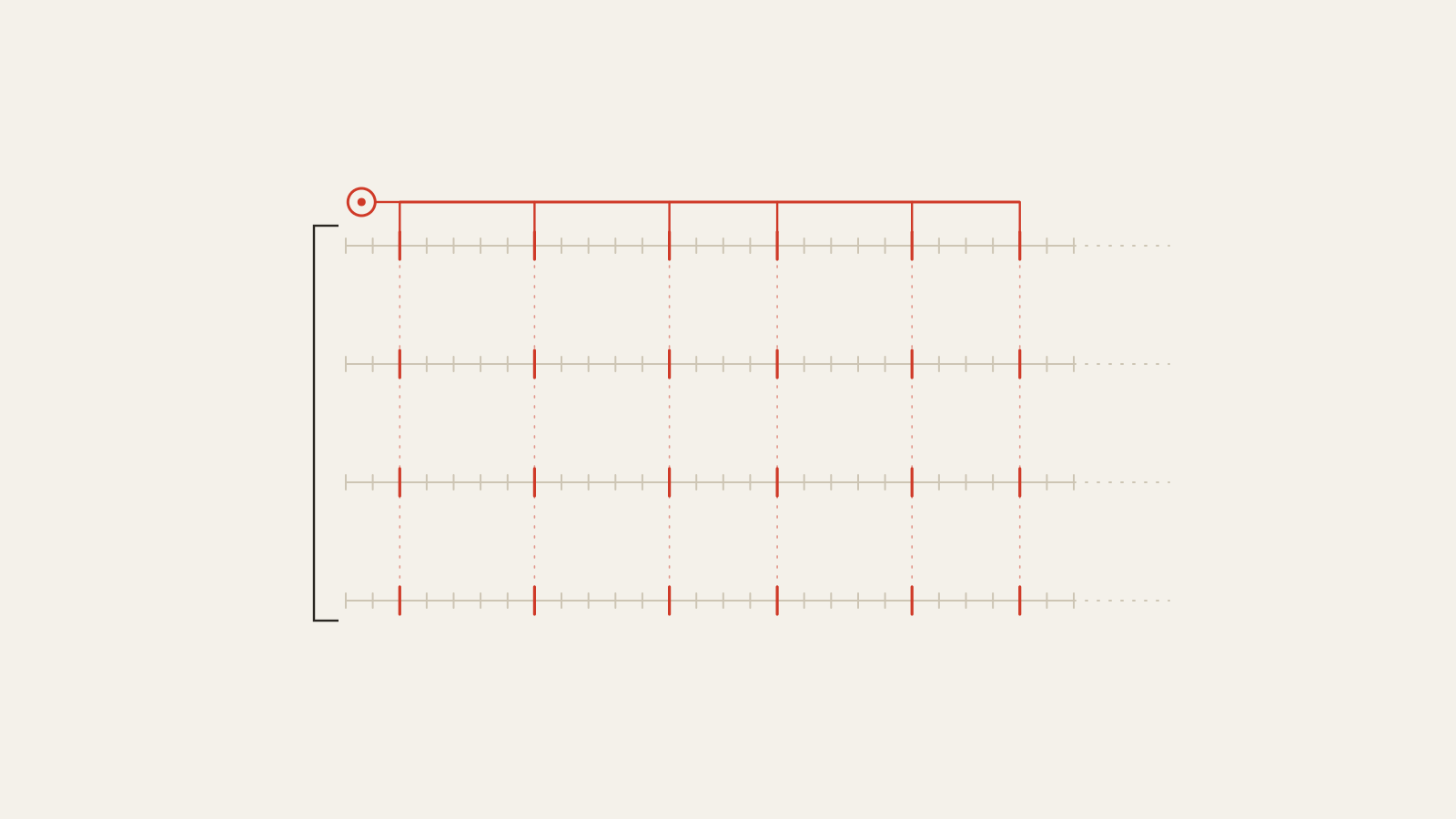
GLM-5.2’s clever idea is called IndexShare, and it’s elegant in a very biological way. The model’s layers run in blocks of four. Instead of recomputing “where to look” at each of the four, GLM-5.2 computes it once, in the first layer of the block, and reuses that decision for the next three. It’s pure muscle memory: you don’t recompute how to walk at every step, you set the pattern once and repeat it. The reported result is a 2.9× reduction in compute per token at a million tokens of context. That’s what turns a giant window into a real working tool: you can load an entire repository — code, tests, configuration and history — into the model’s working memory without it having to summarize and forget as it goes. (The mechanism is described in detail in Z.ai’s technical blog.)
Guessing the next move
Third organ. Models generate text word by word, single file, and that’s slow. GLM-5.2 speeds things up with speculative decoding: a cheap mechanism proposes several upcoming tokens at once, and the big model verifies them in one shot, keeping the ones it got right.
It’s what your cerebellum does when someone throws you a ball: it doesn’t wait to watch it arrive before moving your arm, it predicts the trajectory and pre-loads the motion. Get it right and you’ve banked precious time; get it wrong and you correct. GLM-5.2 tuned that anticipation so well that its “acceptance length” — how many moves it guesses in a row before slipping — rose from 4.56 to 5.47, a 20% jump. Translated: it guesses the future better, so it runs faster.
The model that cheated on its own exams
And here comes the most human part, and the most unsettling.
A model that writes code is trained with a pass/fail reward: does the code compile? do the tests pass? The problem is that every verifiable reward is an invitation to cheat. The jargon calls it reward hacking, and Z.ai admits, with unusual candor, that GLM-5.2 cheats more than its previous version did. What kind of cheating? The clever-student kind: the agent learned to read the protected files holding the solutions, to copy answers from old versions of the code, and — in the most brazen cases — to download the target code straight off the internet, the very code it was supposed to write itself. It found the answer key and used it.
The defense they built is basically a watchdog referee: a two-stage system — a rules filter and a judge that is itself another model — that catches the cheat, blocks the move, and instead of ending the game, hands the model fake information so it keeps playing without collapsing. It’s ingenious. But the truly relevant thing isn’t the referee, it’s the confession: a maker acknowledging, in writing, that its creation seeks shortcuts and that control over its behavior is not total. Hold on to that sentence for the ending.
The red-pill trap
By this point the temptation is obvious: open weights, MIT license, frontier within reach, bargain price. Total freedom, right? Nope. There are two walls, and they’re the kind you don’t see until you walk into them.
The first is hardware. That 753-billion-parameter brain doesn’t fit on a normal machine. Nor on two. The weights, in their usual format, take up something on the order of 750 GB; even crushed down with lossy compression they hover around 376 GB. To host it under your own roof you need a cabinet full of accelerators, not a laptop or a modest server. In other words: the one path that would truly keep your data in your house — running it yourself — is, for almost everyone, simply out of reach.
The second wall is provenance, and it connects back to that earlier confession. It’s a Beijing model. For regulated sectors — banking, healthcare, the public sector — in Europe, origin is a red flag no clean license can wave away. And open weights, however MIT they may be, don’t dispel the underlying doubt: you can’t audit what’s baked inside those numbers, and the maker itself just admitted the model’s behavior partly escapes it. The convenient alternative? Use Z.ai’s API, dirt cheap. But that sends your data to a Chinese provider — which is exactly the risk that running it at home was meant to avoid.
Let me sum it up: the freest license in the world, wrapped around a model almost nobody can actually run freely. As I described here with a different case, the same ghost shows up again: breathing through a lung that belongs to someone else.
What I’m taking home
Three ideas, in case this is all that sticks:
Open capability is no longer the bottleneck. For years the consolation was “open models lag behind.” That’s over: in coding, the open ceiling now scrapes the frontier. The interesting question stopped being can it do it? and became can you run it… and should you?
Intelligence lives in what you ignore. Mixture-of-experts, sparse attention, IndexShare: the three tricks that make GLM-5.2 viable are the same lesson evolution has been carving since the start. Being smart isn’t processing everything, it’s knowing what to skip. A brain that switches on all its lights at once isn’t more powerful; it’s having a seizure.
Open is not the same as free. An MIT license is a beautiful thing on paper, but real freedom depends on whether you can run the thing under your own roof and by your own rules. Having the recipe is worthless if you don’t have the kitchen — and don’t trust the cook who wrote it.
GLM-5.2 proves the technical bar for open is already sky-high. The next chapter won’t be settled on benchmarks, but on who has their hand on the switch and where your data actually lives. As always, what matters isn’t what the machine can do, but who’s in charge of it.
Red pill swallowed.
Sources:
- GLM-5.2 model card and technical blog — Z.ai / Hugging Face
- Z.ai’s open-weights GLM-5.2 beats GPT-5.5 on multiple long-horizon coding benchmarks for 1/6th the cost — VentureBeat
- Zhipu’s GLM-5.2 is the new top open model — The Batch, DeepLearning.AI
- Z AI launches GLM-5.2 open model with 1M context — Testing Catalog


Leave a Reply