
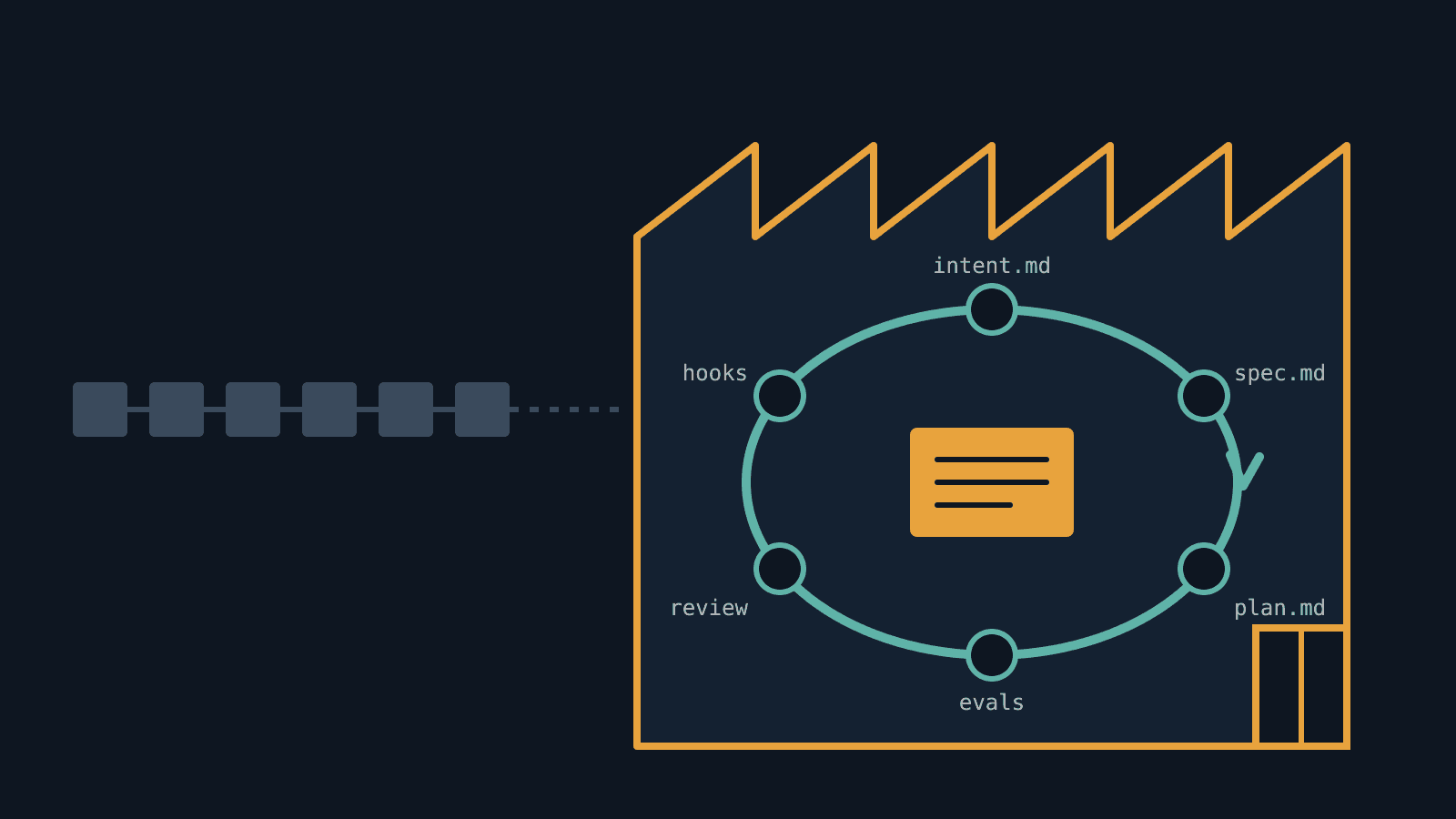
In August, Anthropic published a playbook with a thesis I’d sign from the first paragraph: writing code is no longer the slow part. I read it with a pencil in hand, next to the latest articles in this series. This one is about what it proposes, where it matches the software factory I’ve been describing, where it doesn’t, and the question I think it leaves unasked.
Listen in my voice · 12 min
Speed:
Every factory has two documents that look nothing alike. One is the line manual: what each station does, which part it hands to the next one and how you check the part is right before passing it on. The other is the building plan: where the walls are, who has the key to each door, where the logbook is kept and how you get out if there’s a fire.
You need both, and neither replaces the other. With a good manual and no plan, the line works until the day someone walks in through a door nobody locked. With a good plan and no manual, you have a beautiful, empty building.
Anthropic’s AI-native SDLC playbook is, to me, the best line manual anyone has written so far for a software factory. It is not the building plan, and it doesn’t claim to be. Reading it that way helps you get the most out of it without asking it for things it never promised.
(SDLC stands for software development lifecycle: plan, design, build, test, deploy and maintain.)
What the playbook proposes, in five minutes
It’s written by Louis Claxton, from Anthropic’s Applied AI team, dated August 21, 2026, and it gathers practices from that team and its customers. It starts from a diagnosis anyone working with agents will recognise: agents have sped up the build, but everything around it (approvals, handoffs, weekly committees, line-by-line code review) still runs at human speed. The bottleneck has moved.
The answer rests on three ideas:
- The line becomes a loop. The six usual stages are still there, but each one ends by committing a versioned artifact that the next one reads:
intent.md,spec.md,plan.md, the code and its tests, and the review evidence. Whatever is detected in production comes back in as a newintent.md. - Controls change form. Reviewing every line by hand doesn’t scale once agents write most of the code. Policy is written into skills, hooks and automated review passes that act while the agent works.
- People stay accountable, but above the loop. They set intent, approve the gates and make the calls that need judgment.
Each stage is organised into plays: what changes, how to get started, what to consider for governance and how to measure it, with leading and lagging indicators. A dependency graph tells you in which order to adopt them. It’s a very practical document, full of Claude Code configuration examples.
Five places where it matches the factory
1. The organisation, written down as text
In the anatomy of a dark software factory I said the first non-negotiable piece is the organisation’s definition of itself, stored as versioned text. The playbook takes the same road. An idea is captured once, in conversation with Claude, as an intent.md with the problem, the expected outcome, the users and systems affected, the constraints and the open questions. The product owner corrects it before the commit, and the chain of commits becomes the record: who asked for what, what the agent produced and who approved it.
There’s a nuance I care about. In my intake, “unknown” is a valid answer, and nobody may fill a gap with a value that merely sounds reasonable. The playbook trusts the product owner to correct it. That amounts to the same thing if the product owner reads closely. If not, a gap filled with common sense becomes a decision nobody made.
2. The model proposes; a deterministic layer disposes
It’s the line I repeated most in the anatomy piece, and the playbook says it in its own way: “A skill is a control, though an advisory one”. Nothing forces the session to follow it. So any policy that must always hold needs something deterministic behind it, such as a hook that blocks the action. And the gates that aren’t up for negotiation go into managed settings, which the team cannot switch off. It’s the factory’s spinal cord in different clothes.
3. Up to the production gate, and not one step further
The playbook tiers autonomy by environment. In development, the agent deploys freely. In production, it prepares the release and a person authorises it, with a hook enforcing the gate. The agent can go up to the production gate, but not through it. It’s the same idea as my always-lit action classes, applied to one specific case.
4. Evals as training (of the harness, not the model)
Here the overlap with wax on, wax off is almost word for word. Between 20 and 50 real tasks, each with its accepted outcome. The suite runs daily and whenever CLAUDE.md, a skill or a hook changes. If a change lowers the pass rate, it gets reviewed before merging. And every production incident becomes a permanent eval, written by the team that owned the incident.
Two details I like. First, what gets evaluated is not the model but the harness configuration. That’s the conclusion of 62.7 and 99.9: the harness decides the score. Second, a hook that stops the agent from editing test files while it fixes a bug. Whoever does the work doesn’t touch the exam.
5. The reflex before the brain
The maintain stage is my favourite. A deterministic monitor, with no model involved, compares each metric against its rolling average. At one standard deviation, it only logs. At two, it calls Claude in read-only mode to diagnose. At three, Claude may propose a change as a pull request or trigger a pre-approved procedure, such as rolling back. Detection is a reflex arc; the model comes in afterwards, with more room the more serious the signal. Whatever it finds goes back to the start of the loop as an intent.md.
| Anthropic’s playbook | Software factory | Verdict |
|---|---|---|
intent.md, spec.md and plan.md in git | The organisation as versioned text | Match |
| Advisory skills and deterministic hooks | The model proposes; a deterministic layer disposes | Match, different boundary |
| Up to the production gate | Five action classes that are always lit | Partial match |
| Continuous evals on configuration | Evals as daily training | Match |
| Deterministic monitor with tiers | Reflex arc before the model | Match |
| Commits and pull requests as the record | Single-writer journal that also keeps the “no”s | Missing |
| Budget to run evals | Cost per task, with measured caps | Missing |
Where it doesn’t match: the harness is not the building
Now, the seams. They aren’t mistakes in the playbook. They are the border between a line manual and a plan.
The deterministic layer lives inside the harness. Hooks, managed settings, allowlists of MCP servers, a sandbox that denies credentials. All of it is good and I recommend it. But it protects one session, one repository, one machine. In the anatomy piece I put authority outside: a single boundary that every action by every agent crosses, and a kernel with the rules in one place. Hooks are the first ring; the boundary is the wall. They don’t compete: they add up.
Autonomy is tiered by environment, not by what the action does. Development is free, production has a gate, and staging, in the document’s own words, sits somewhere in the middle. But an email to a customer, a financial commitment or a write to a system of record aren’t dangerous because of the environment they happen in, but because of what they are. That’s why I prefer to split each critical journey into segments and ask, segment by segment, who decides.
The record keeps the “yes”es. Commits and pull requests tell you who asked, what was done and who approved it. They don’t tell you what was attempted and denied. A journal that only keeps what was allowed is a photo album.
Identity reaches the session, not the chain. The playbook does say that unattended runs should act under their own identity, and it does classify data: a field tagged as personal data that must never reach the logs. That’s more than I expected. What’s missing is what the whole chain of agents has seen before a “clean” subagent sends data out. That laundering-by-delegation problem belongs to the plan, not the manual.
Cost barely shows up. The only mention I found is having an API key with budget to run the evals. In a factory that works through the night, cost per task and per accepted deliverable is one of the first things you need to measure.
People above the loop. I like the image, but I’d also put them inside, in the segments where the lights never go out. “Above” sounds like supervising; some decisions aren’t supervised, they’re made.
The question the loop doesn’t ask
The playbook signs off with a nice idea: the loop keeps running and human judgment stays above it. My question is the opposite: when does it stop?
The document is honest about part of the problem. It admits that evals wear out: as models improve, cases that used to separate good from bad stop doing so, and the suite has to keep growing. And it guards against the most obvious trick: an agent fixing a bug must not be able to weaken the check on that code.
What it doesn’t say is when an improvement loop has learned enough, or what to do when an agent learns to pass the exam instead of doing the work, in ways subtler than touching a test. That will be the next instalment in this series: the stopping condition as the backbone, and eval gaming as the reason.
The fine print
Three uncomfortable points, as usual.
There’s no outcome data. The playbook proposes indicators for each play, but publishes no measurements. It’s a manual, not a study, and should be read as one.
It leaves user experience out. Tanner Kohler, at Nielsen Norman Group, critiques it in depth: the intent.md doesn’t have to start from a real user need, testing checks the result against the team’s own design rather than its usability, and monitoring looks at technical health, not whether people get what they came for. He’s right, and the criticism applies to my factory too. Kohler also points out an obvious conflict of interest: a lifecycle with agents at every stage means more use of the proposer’s products. It doesn’t invalidate anything, but it’s worth reading with that in mind. Several of the pieces are also still in beta or preview.
My factory isn’t finished either. I said it in the anatomy piece and I’ll say it again: it has parts built, parts in shadow mode and parts still on the drawing board. I’m comparing a published manual with an architecture in progress, and that’s not a fair fight for either of them.
What I’d do on Monday
- Write your next request as an
intent.mdand commit it, with “unknown” as a valid answer. - Take your team’s most important skill and underline what must always hold. That isn’t a skill: it’s a hook.
- Add a hook that blocks edits to test files during a fix.
- Gather twenty real tasks and run them every time
CLAUDE.mdor the.claudefolder changes. - Draw one critical journey twice: by environment and by action class. Wherever the two drawings don’t match, you have a gate in the wrong place.
What I take away
I’d sign a good part of this playbook, and that’s exactly why reading it next to what I’ve built is so useful. Where it matches, it tells me the road is a reasonable one: versioned text, deterministic layers, evals as training and reflexes before brains. Where it doesn’t, it reminds me which part of the work doesn’t fit in a manual.
A line manual tells you how a part moves from one station to the next. The plan tells you who can walk onto the factory floor at three in the morning, and where it’s written down that they did. A dark software factory needs both.
The loop keeps running. The question is who keeps the journal.
Ideas over codebases; evidence over hype.
Sources
- Claxton, L. (August 21, 2026). The AI-native SDLC playbook, Anthropic. Also as a PDF: stages, plays, artifacts, skills and hooks, continuous evals, maintenance tiers and the production gate.
- Kohler, T. (October 30, 2026). A UX reading of the playbook, Nielsen Norman Group.
- Earlier articles in this series: Anatomy of a dark software factory, Wax on, wax off and 62.7 and 99.9.

Leave a Reply