
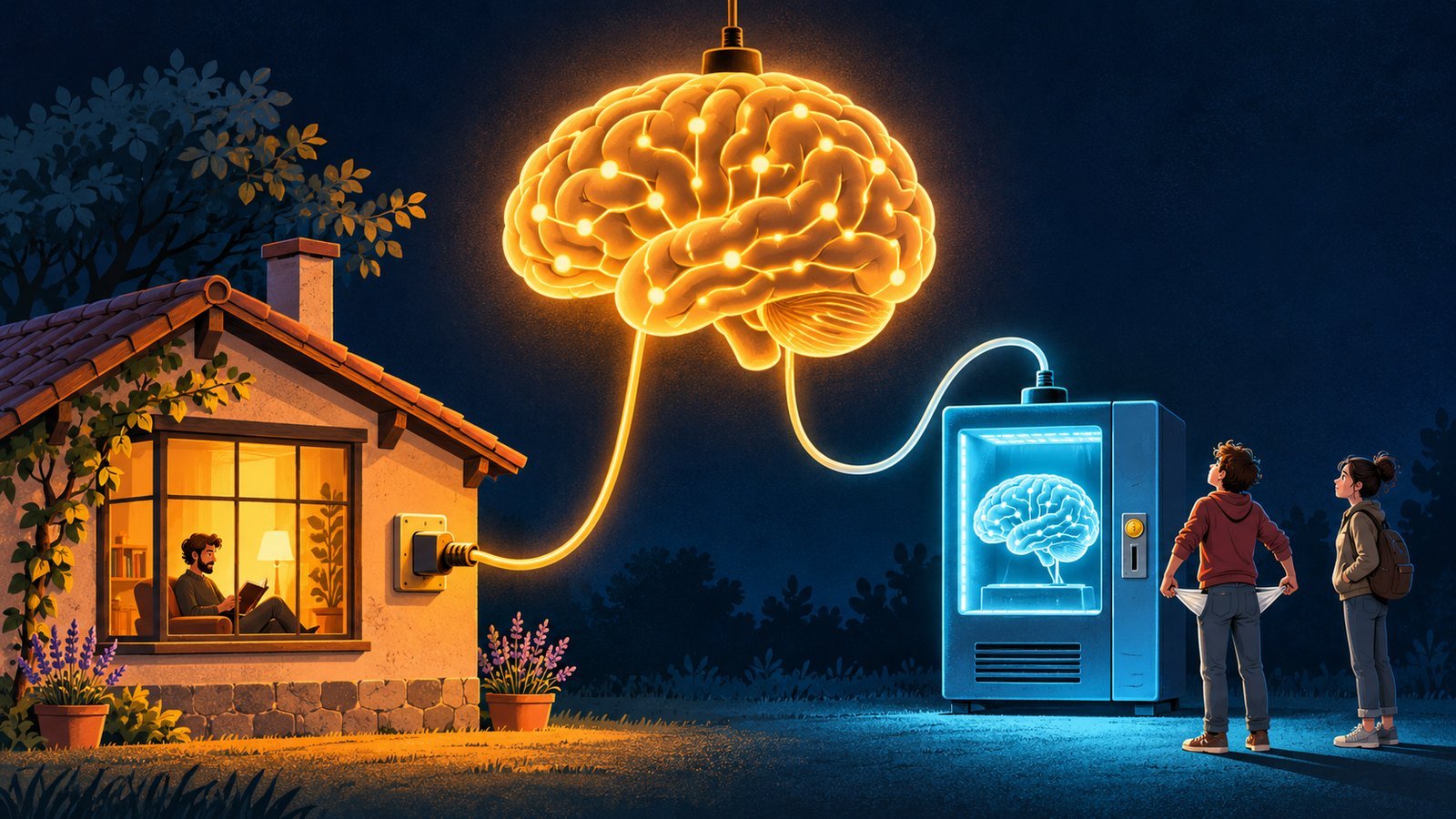
Why AI has to be infrastructure before the usual suspects get to share it out.
Listen in my own voice · 15 min
Speed:
Two headlines in the same week
The same week a lab announces we will soon have “a country of geniuses in a datacenter”, Spain’s Youth Emancipation Observatory reports that only 14% of young Spaniards live outside their parents’ home. The average age for leaving: 30. The Observatory opens its report admitting it has lost count of the editions in which it announced the worst figure on record.
This is not a coincidence I bring up for effect. It is the contradiction I have not been able to get out of my head for months. For three years we have been told that artificial intelligence will bring abundance: cure cancer, double GDP, free humanity from the work it doesn’t want to do. Meanwhile, the generation that is supposed to inherit that abundance cannot pay for a room.
In Europe, one in four people aged 15 to 29 lives in overcrowded housing. Among those at risk of poverty, almost half. Three in ten young Spaniards are at risk of poverty or social exclusion. These are not figures from a country in crisis. They are figures from a continent in the middle of an AI investment cycle, with new data centres announced every week.
Housing is just the most visible example. I could talk about wages that don’t keep up with prices, part-time contracts, making it to the end of the month with a degree and two languages. What they have in common is not economics: it is that they have sat for years on the desk of the same political class, which looks at them, cites them on the campaign trail and does not solve them. The question I want to ask here is not whether AI will create wealth. I think it will. The question is whether we are going to let it be shared out by the same people who failed to share out what came before.
The means of cognition: the new AI divide is not about access, it’s about ownership
For twenty years we talked about the digital divide and we meant something simple: who has a connection and who doesn’t. That divide has almost closed in Europe and we have filed it as solved. But the divide that is coming is not about access. It is about ownership.
Two sociologists, Massimo Ragnedda and Maria Laura Ruiu, have just published a book with what I think is the most useful idea in this whole debate: we are moving from inequalities of participation to inequalities of prediction. Power concentrates in whoever owns and controls what they call the means of cognition. I like the term because it is an obvious nod to the means of production, and because it describes exactly what I see every day. I prefer to talk about the economy of cognition: who produces intelligence, who rents it, and at what price. Because that, in the end, is what decides which side of the divide you land on.
Let’s be honest about who can do what, and I’ll start with myself. At home I have two machines. One, with an RTX 4070, is my test bench: that’s where I load models, try them out, train small things. The other, with a 5070, is for everyday life. It runs my own Whisper and a small voice studio: I transcribe audio and documents, turn articles I want to read into audio and take them on my phone to listen to while I walk. For the internal training of my Data & AI department, I generate an audio version of every chapter. Now and then I experiment with voice synthesis, just to see how far it goes. And with Apollo I generate experimental electronic music, with its videos and its mixes: not to publish it, but to understand what happens when the machine composes and I only decide.
And there is a third device, the smallest and the one that says most about where this is going: a Raspberry Pi 5 with the AI HAT+ 2 and 8 GB extra. It runs Paperclip on top of OpenClaw as my agent orchestration system. I have a finance agent, a legal one, a planner, a knowledge manager and an infrastructure engineer. They are not five chatbots: they share a harness made of skills, hooks, memory and a dynamic context of my “stuff”, so that each one knows what the others have decided. It is, quite literally, a small personal department running on a board the size of a credit card.
None of that depends on a subscription. Nobody can cut it back, change its price, or change its behaviour one random morning. It is my own private Neo: it doesn’t understand everything, but it programs me what I need to live experiences that used to take a team of people. And it cost what it costs: two graphics cards, a board with an accelerator, many hours and a training not everyone has.
Everyone else, which is almost everyone, rents. They pay twenty euros a month for a window onto someone else’s intelligence, under whatever terms of use the owner decides, with whatever memory the owner decides to give it, and with whatever biases the owner decides not to fix. And when they can no longer pay those twenty euros, because they are twenty euros competing with the rent on the room, they are out.
The World Bank sums it up in one line: compute is the new electricity, essential and unevenly distributed. But I would say electricity is a better metaphor than it looks. What changed people’s lives was not that electricity existed, but that it was decided, politically, that it would reach every home at the same price. Nobody had to build their own power plant. With AI that decision has not yet been taken. And until it is, the difference between those who build their own plant and those who rent light by the hour will be the new barrier between societies. Precisely the one many of us who work in this field say we want to avoid.
Wall-E and Ready Player One: two futures I don’t want
When I talk about this with people outside the industry, the same two images always come up. They are useful to me because they are the two extremes of the same mistake.
The first is Wall-E. Humanity floating in a spaceship because Earth is no longer fit for use, each person in their recliner, a screen a hand’s width from their face, not walking, without bones that can carry their weight. The machine does everything and people no longer know how to do anything. It is the dystopia of passivity: guaranteed abundance in exchange for atrophy.
And it is not entirely science fiction. A 2025 study from the MIT Media Lab measured the brain activity of students writing with and without an assistant. Those who relied solely on the chatbot could not quote their own text or defend their argument. The authors call it cognitive debt, and the most unsettling part is the equity angle: whoever starts with less skill accumulates that debt faster and benefits less. Wall-E‘s ship is not for everyone. It is for whoever cannot afford not to board.
The second image is Ready Player One. People stacked in containers, one on top of the other, and their way out is to enter a virtual world where everyone has another identity and another life. What is valued there are the most powerful goggles, the most sensitive suit, the gear that gives you the precision to operate better in an economy with its own politics and its own network of power. It is the dystopia of escape: reality has become unliveable and the technology doesn’t fix it, it just sells you a door so you don’t have to look.
Notice that both accept the same premise: that the physical world, the one with houses, wages and food, is already lost, and that technology only decides how you cope with it. I reject both for that reason. Not because they are exaggerated, but because that premise is, at bottom, an alibi. It is what allows those who govern to talk about AI as the future while the present rots in their hands. If a 26-year-old spends their entire salary on a room, the question is not which AI model we put on their phone. It is why those with the power to decide prefer to inaugurate data centres rather than solve what has gone unsolved for a decade.
The netocrats were already here
What Ready Player One tells as fiction, two Swedes wrote as a thesis in the year 2000. Alexander Bard and Jan Söderqvist published Netocracy with an idea that sounded like a provocation at the time: after capitalism, power will not lie with those who own the means of production, but with those who sort and distribute information. The only hard currency on the net is attention. Opposite that new elite, the netocrats, they described a new underclass they called the consumtariat: people whose main function is to consume, regulated from above.
Twenty-six years later, the description is almost literal. And AI adds a twist that Bard could not foresee: now the one sorting the information is not an editor or a recommendation algorithm, but a model that talks to you and answers with the friendliness of a friend. The consumtariat no longer just consumes content. It consumes judgment.
Here is the point I think matters most in this whole piece. Netocracy is not defined by how much technology you use, but by whether you are on the side that configures it or the side that receives it configured. Whoever has their model running locally and tunes its behaviour is in the first group. Whoever pays the subscription and accepts the terms is in the second. And the difference between the two is not talent. It is time, money and training. In other words, it is the same old difference, under a new name.
One clarification, because the word is ambiguous. Netocracy is also used, especially in the United States, to mean the opposite: internet-enabled democracy, where issue-based politics replaces party politics. I use it in Bard’s sense: an elite, not a system. Although, curiously, the second meaning is the one I would like to end up being right.
The third way: AI as infrastructure, not as a product
If I reject the ship and I reject the goggles, I have to say what I want. And what I want fits in one idea: that artificial intelligence be treated as infrastructure, not as a product. Like water, electricity or the road. Something that reaches every home, that nobody has to build on their own, and whose price and behaviour are not decided by a private owner one random morning.
This is not a fantasy. There are pieces on the table. Sam Altman has proposed a compute budget for every person, a kind of basic income of intelligence. Europe has launched the AI Factories, publicly subsidised compute for those who cannot pay for a private cloud. India has launched its own national mission. And there are open-weight models anyone can run without asking permission. They are loose pieces, but the picture can be made out: public compute, open models, and the right to audit what affects you.
Daron Acemoglu, Nobel laureate in Economics in 2024, has been saying for years that technology does not distribute its benefits on its own: they get distributed, or not, depending on who decides how it is deployed. And he warns of a dynamic that worries me more than robots: whoever makes money from AI gains political influence, and with it decides the rules of the next round. It is a loop. The only way to break it is to decide the rules before the loop closes.
There is a second face to this third way that interests me almost more, and it is the political one. We tend to assume AI will polarise us further, because that is what social networks did. But an experiment published in Science in 2024 tells a different story. A DeepMind team trained a model, the Habermas Machine, to mediate between groups of Britons discussing Brexit, immigration or the minimum wage. The model did not give its opinion. It listened to everyone, drafted a common statement and kept correcting it with each person’s critiques. The groups ended up less divided than with human mediators, and minority voices were incorporated into the final text.
That is what I mean by AI focused on the human: not one that decides for us, but one that helps us hear each other without the noise of ideology. I don’t ask AI to be right. I ask it to help me understand what the person who thinks differently really wants. And for that, once again, it has to be an infrastructure we trust, not a product whose owner has a stake in the outcome.
What is not inevitable: a political decision
Back to the two headlines from the start. The country of geniuses in a datacenter and the 14% of emancipated youth. The temptation is to treat the first as the future and the second as the present that future will fix. I think it is the other way round: the second headline is the proof of how abundance gets shared out when those who must decide do not decide. And the first is the next abundance those same people are going to have to share out.
Housing, wages, precarious work: none of those problems went unsolved for lack of technology. They went unsolved because, for an entire generation of political leaders, managing the problem has been more profitable than ending it. With artificial intelligence we still have time for the same thing not to happen, but only for a few years, however long Acemoglu’s loop takes to close. And that loop closes, precisely, in the office of whoever is not deciding today.
I don’t want a ship with recliners or a headset so I don’t have to look at the street. I want a 26-year-old, with or without technical training, to have their intelligence the way they have their electricity: at home, their own, at a price that doesn’t eat the rent. And I want that same intelligence to help us argue about all of this without shouting at each other and, above all, without anyone being able to hide behind ideology to do nothing. None of this is a prediction. It is a decision. And we already know who has spent years not taking it.
Ideas over codebases; evidence over hype.
Sources
- Youth Emancipation Observatory, Spanish Youth Council (via Forbes España, in Spanish)
- Youth Wiki: Housing affordability for young people in Europe
- Ragnedda and Ruiu, The Inequality Regime of AI (Routledge, 2026)
- World Bank, Digital Progress and Trends Report 2025
- Acemoglu and Johnson, Power and Progress (MIT News)
- Tessler et al., “AI can help humans find common ground in democratic deliberation”, Science, 2024
- Bard and Söderqvist, Netocracy
- Cognitive debt, MIT Media Lab study (Diginomica)
- Altman and the compute budget (The Decoder)

Leave a Reply