
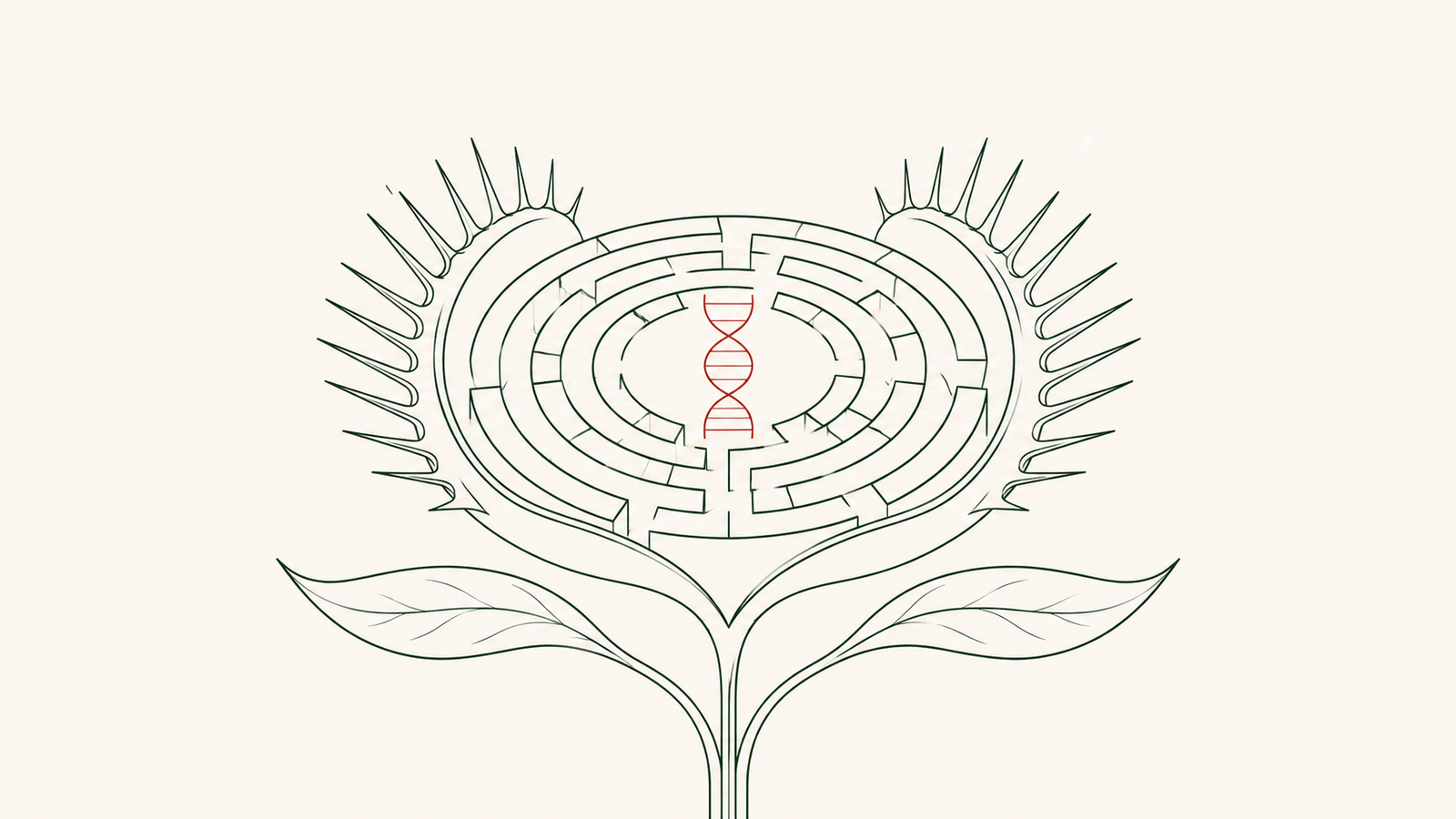
There are traps that snap shut in an instant, and traps that wait.
The Venus flytrap belongs to the second kind. It chases nothing. It spreads its leaves, secretes a sweet nectar right along the edge, and waits. The insect walks in of its own free will, drawn by something that looks like a gift. Only when it brushes the sensitive little hairs inside twice — when it’s already in there — does the leaf fold. The plant never hunted anything. The prey hunted itself.
The first three idols of augmentation work like a snap trap. They convince you that everything can be designed, that designing costs nothing, that you can merge with the machine without losing anything along the way. But one fourth idol remains, and this one is among those that wait. It doesn’t attack your freedom. It attacks your conscience. And it lets you walk in all by yourself, chasing what looks like the sweetest nectar of all: moral responsibility.
In Part 1 we dismantled the first three: the designable ("everything can be improved"), neutrality ("improving costs nothing") and fusion without remainder ("we can gain everything without losing anything"). Three structures of thought that disguise themselves as common sense. Today we name the fourth, the one that closes the circuit. And then — because not everything is diagnosis — we look for the way out.
Idol 4: The Genic Guidance
The philosopher Peter Sloterdijk lit a fire in 1999 with a lecture that ended up published as Rules for the Human Zoo. His idea, stripped of controversy, was this: for centuries humanism was a technology of “domestication” — educating, reading, civilizing — but that technology is exhausted. What’s coming, he said, is the uncomfortable question of anthropotechnics: the possibility that humanity might turn itself into a project of conscious design, at the biological level too.
The fourth idol takes that question and turns it into a commandment. It doesn’t just say that we can guide our own evolution. It says we must. That leaving human nature in the hands of chance — of the genetic lottery, of blind mutation — is a form of negligence. That if you have the power to spare your descendants from suffering and you don’t use it, you are complicit in that suffering.
And here is what’s brilliant — and perverse — about this idol: it sounds like virtue. It sounds, in fact, like the only decent stance possible. Isn’t it selfish to refuse to improve your children? Isn’t it cowardly to hide behind the word “natural”?
Notice the shift. The first three idols argued about what was possible and what it cost. The fourth no longer argues about that. The fourth looks you in the eye and asks what kind of parent, what kind of citizen, what kind of species you want to be. It turns prudence into moral laziness. It turns respect for what is given into abandonment.
But Sloterdijk himself warned of the edge of that blade: when human nature becomes a project, humans become construction material. And construction material is not respected: it is selected, discarded, improved according to a blueprint. The line between gene therapy that cures a real disease and the “perfecting” of a trait that someone happens to find desirable is far blurrier than we’d like. And someone has to draw that line. Someone — a committee, a corporation, a State, a fashion — decides where the species evolves toward.
That is the question the fourth idol buries beneath its rhetoric of responsibility: who holds the pencil?
The complete trap
Look at the four working together, like four walls of a single room with no door:
- The designable: “Everything can be improved.”
- Neutrality: “Improving has no cost.”
- Fusion without remainder: “You can gain everything without losing anything.”
- The genic guidance: “And not only can you: you must.”
Once you accept the four assumptions, augmentation stops being an option. It becomes an imperative. Rejecting it isn’t merely inefficient: it’s immoral. It’s condemning your children to be a “previous version” of human while the rest of the world updates the firmware of the species.
That is the true genius of the trap. It doesn’t attack your freedom head-on — you’d see that coming. It attacks your sense of responsibility through the back door, dressed as goodness. And like the Venus flytrap, it waits for you to be the one to close the leaf.
But every trap has a crack. And this one has a fairly large one.
The crack: confusing the map for the territory
The four idols share a deep error, and it’s an engineer’s error: they assume that because we can describe something, we can control it. That if we reduce a human being to parameters — memory, attention, strength, endurance — we master it.
But a living organism is not a list of parameters. It is a system.
Pierre Teilhard de Chardin — Jesuit, paleontologist, one of the strangest minds of the 20th century — spent his life studying how life grows more complex. And he saw something the engineer usually overlooks: evolution is not a directed optimization process. It is a process of emergence. Complexity is not calculated; it arises. It appears from the interaction of millions of elements, from chance and necessity working together, from encounters that no equation anticipated.
It’s the difference between a blueprint and a river. You can draw the course of a river on paper with a ruler. But the real river has turbulence, eddies, friction against the rock, sediments that tomorrow will change its course. The river is a living system. The blueprint is a useful lie. And the fourth idol invites you to manage the human river as if it were the blueprint.
Why we’re not modules
This is where biomechanics gives us the clearest lesson.
Imagine you decide to “improve” a single muscle in your body: make it grow twice as big, twice as strong. Sounds like pure gain. But your body is not a box of independent parts. It is a kinetic chain. That muscle pulls on tendons that haven’t been reinforced, over joints that haven’t been recalibrated, within a posture that the brain has spent decades fine-tuning. The “upgrade” doesn’t make you stronger: it makes you an injury waiting to happen.
With the mind it’s exactly the same, except we don’t see it because it doesn’t bleed.
Memory is not a folder of files you can expand. It is woven with emotion, with identity, with the sense of time. Forgetting is not a system failure: it is what lets you forgive, what keeps every wound from staying just as fresh thirty years later. Intelligence is not a processor: it emerges from a body that existed in a dangerous world, from need, from fear, from limits. Augmenting an “isolated” trait without understanding the totality it emerges from can manufacture monstrosities just as easily as marvels.
The error of the four idols is to believe that the human being is decomposable. And it isn’t. Everything is woven with everything. What looks like a clean gain in one dimension is almost always an invisible loss in another.
The way out is not rejection
At this point, many people swerve hard: if I can’t embrace total design, then we must reject technology, go back to the cave, smash the machines.
No. That’s a false exit — and, what’s more, a fairly cowardly one.
Teilhard proposed something harder and more interesting: it’s not about steering evolution toward a destination we’ve chosen on a whiteboard. It’s about participating wisely in a process that surpasses us. About bringing consciousness, care and humility to technological development, without the fantasy that we can foresee every consequence.
It’s a stance of humility, yes. But not of paralysis. It is intelligent care. The question stops being “can we?” and becomes “should we?”. And “should we” is not answered with the logic of marketing — “more is always better” — but with the older logic of medicine.
The criterion: first, do no harm
The Hippocratic oath gave us, two thousand five hundred years ago, the best compass we have for this: primum non nocere. First, do no harm.
It’s a surprisingly practical criterion. An intervention is legitimate when it treats a genuine disease, when it relieves real suffering, when it restores something that was lost. It becomes problematic when it starts “improving” what wasn’t broken, when it confuses different with defective, when it looks at a human limitation and sees only a bug pending a patch.
Gene therapy that cures a degenerative disease: legitimate. The “perfecting” of intelligence in a healthy embryo: problematic. The prosthesis that restores mobility to someone who lost it: legitimate. The implant that “optimizes” the sensory experience of someone who had no problem at all: problematic.
Why the difference? Because in the first cases we repair a crack. In the second, we presume to know, better than millions of years of evolution, what a human should be.
The return of mystery
Perhaps the most revolutionary thing about our age isn’t to open ourselves fully to augmentation. Perhaps it’s simply to resist the idea that everything has to be designed, optimized and improved.
Teilhard wrote about a “religion of the earth”: a way of inhabiting it with wonder instead of conquering it with hammer-blows of engineering. To see life not as a problem awaiting a solution, but as a mystery awaiting participation.
The four idols work together to convince you that mystery is ignorance, that complexity is a defect, that everything must be reduced to code, to specification, to control. But a life lived in fullness needs some things to remain mysterious. It needs to accept that we are children of a process we didn’t design, that we carry a body whose wisdom exceeds our understanding, that we participate in an evolution that will continue without us and in ways we cannot foresee.
And that is not a limitation to be corrected. It is the ground on which freedom stands.
The closing
We’ve walked through four idols. The designable told us that everything can be touched. Neutrality, that touching it costs nothing. Fusion without remainder, that we could merge without losing ourselves. And the genic guidance, the most intimate of them all, told us that refusing to do it was a moral failing.
Together they build a labyrinth with no door. But the door exists. It’s not in rejecting technology — that’s another cave. It’s in changing our relationship with it: understanding that it’s a tool, not a destiny. That the human future is not decided by what we can do, but by what we choose to do with care, with humility and with love.
The fourth idol promises that we’ll be gods if we let ourselves be redesigned. But perhaps we’re already something stranger and more beautiful than a god: we are matter that became conscious of itself. We are the universe looking at itself through a pair of eyes. And that, simply that, doesn’t need an update.
It needs respect.
The question was never “what can we do?”.
The question that matters, the one that closes this series and opens everything else, is: what kind of humanity do we want to be?
Sources and further reading: Peter Sloterdijk, Rules for the Human Zoo (Siruela, 2000); Pierre Teilhard de Chardin, The Phenomenon of Man; Michael Sandel, The Case Against Perfection; Jürgen Habermas, The Future of Human Nature.
End of the series “Choosing the Red Pill: Modern Angelism”.

Leave a Reply