
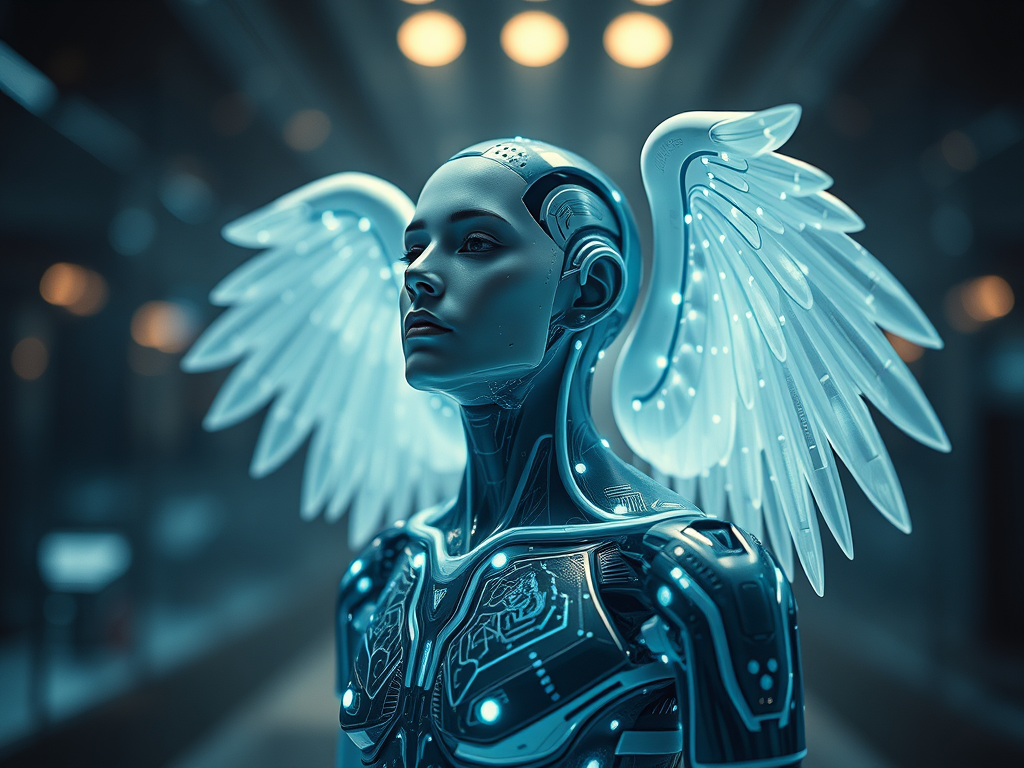
There’s a moment when the logic of "human augmentation" stops looking futuristic and becomes the present. You see it in the neurotech proposals that promise augmented intelligence. In the gene-editing plans that seek to optimize the human genome as if it were software with bugs. In the rhetoric of the "human augmented workforce" that imagines a worker fluidly fused with AI systems, frictionless, without remainder, pure performance.
And in that moment you recognize something: we’re not facing a 21st-century novelty. What’s happening now has a name that’s existed for eighty years. It’s called angelism. And the diagnosis that comes with it is so precise it hurts.
Maritain’s Angelism
Jacques Maritain, the French Catholic philosopher, coined the term in the mid-20th century as a surgical critique of Descartes. It wasn’t a critique of Cartesianism as a method, but of its deepest metaphysics: the idea that the human being is, in essence, an angel.
Sounds strange, doesn’t it? But wait.
An angel, in medieval theology, is pure intelligence. It has no body, no material extension, no biological limitations. It exists in a state of perfect transparency between its will and its knowledge. An angel is what it thinks. There’s no mediation, no friction, no flesh to slow it down.
What Maritain saw in Descartes was this: Cartesian philosophy treated the human being as if it were an angel. It reduced the human to the res cogitans — the thinking thing — and relegated the body to the category of res extensa — the extended thing — as if it were an accidental mechanism, something the true self (the mind) only occasionally occupies, like someone leaving the car in a parking lot.
For Maritain, this was a profound metaphysical error. The human being is not an angel accidentally incarnated. It is a rational animal — an inseparable unity of body and spirit, matter and form. The body is not a hindrance. It is a constitutive part of what it means to be human. We are, literally, made of flesh.
And everything else follows from there.
Angelism Today
Maritain’s diagnosis of Descartes is exact. But the unsettling thing is that it perfectly describes what’s happening now, more than three centuries later.
Look at the rhetoric. Look at how the human body is presented in the discourse of augmentation: Not as something that defines us. But as a technical problem.
It’s a problem that can be solved through intervention. The genetics you "inherited" is a bug. Your cognitive capacity is a spec that can be upgraded. Your physical energy, your endurance, your attention — all of that are functions that can be optimized. Your biological limits are unnecessary friction on the road to perfect efficiency. And the solution isn’t learning to live in your body. It’s escaping its constraints.
That is angelism. It’s the belief that your true self — your intelligence, your productive capacity, your potential — is accidentally trapped in a faulty materiality that must be repaired, augmented, designed, corrected. That your essence is pure functionality and that anything that doesn’t accelerate that functionality is a regrettable accident.
Transhumanism is angelism. Germline gene editing is angelism. The "human augmented" is angelism. AI as a cognitive prosthesis that fuses your mind with machines — that’s angelism. And the most revealing symptom is always the same:
the belief that accepting one’s own limits is defeat.
The Central Idol: The Designable
Beneath all this there’s an idol. It’s the most central idol, and it deserves to be named clearly. It’s the idol of the designable as inevitability. The belief that anything that can be technically intervened upon must be open to it. That the alternative — accepting something as given, receiving our capacities as a gift rather than as an engineering project — is superstition. It’s passivity. It’s conformism.
This is where Michael Sandel, in The Case Against Perfection, sees the deepest loss. It’s not a loss of biological security. It’s the loss of what he calls giftedness — the capacity to receive what we are as a gift, not as an achievement. And when you lose that, you lose something that’s enormously hard to explain until you see it disappear: you lose humility, gratitude, and, most unsettling of all, you lose the capacity for solidarity.
Because if everything is design, then whoever received less is not a brother with a different fortune. They are a manufacturing defect.
That’s what’s at stake.
The Thesis of What’s Coming
This central idol — the designable as inevitable — is not alone. There are three others that accompany it, and together they weave a capture so sophisticated that it presents itself as elevation. In the coming posts we’re going to name them. We’re going to see how they work. And we’re going to ask the question no one asks in the discourse of augmentation:
- When is a fusion communion, and when is it capture?
- Because not every synthesis is communion. Some are capture disguised as elevation.
And that’s what modern angelism — with its genetic guidance and its promise of optimization without limits — really is: capture. A beautiful, seductive, irresistible capture.
But capture, in the end.
Next post: The Idols of Augmentation — The three illusions that close the trap.

Leave a Reply