
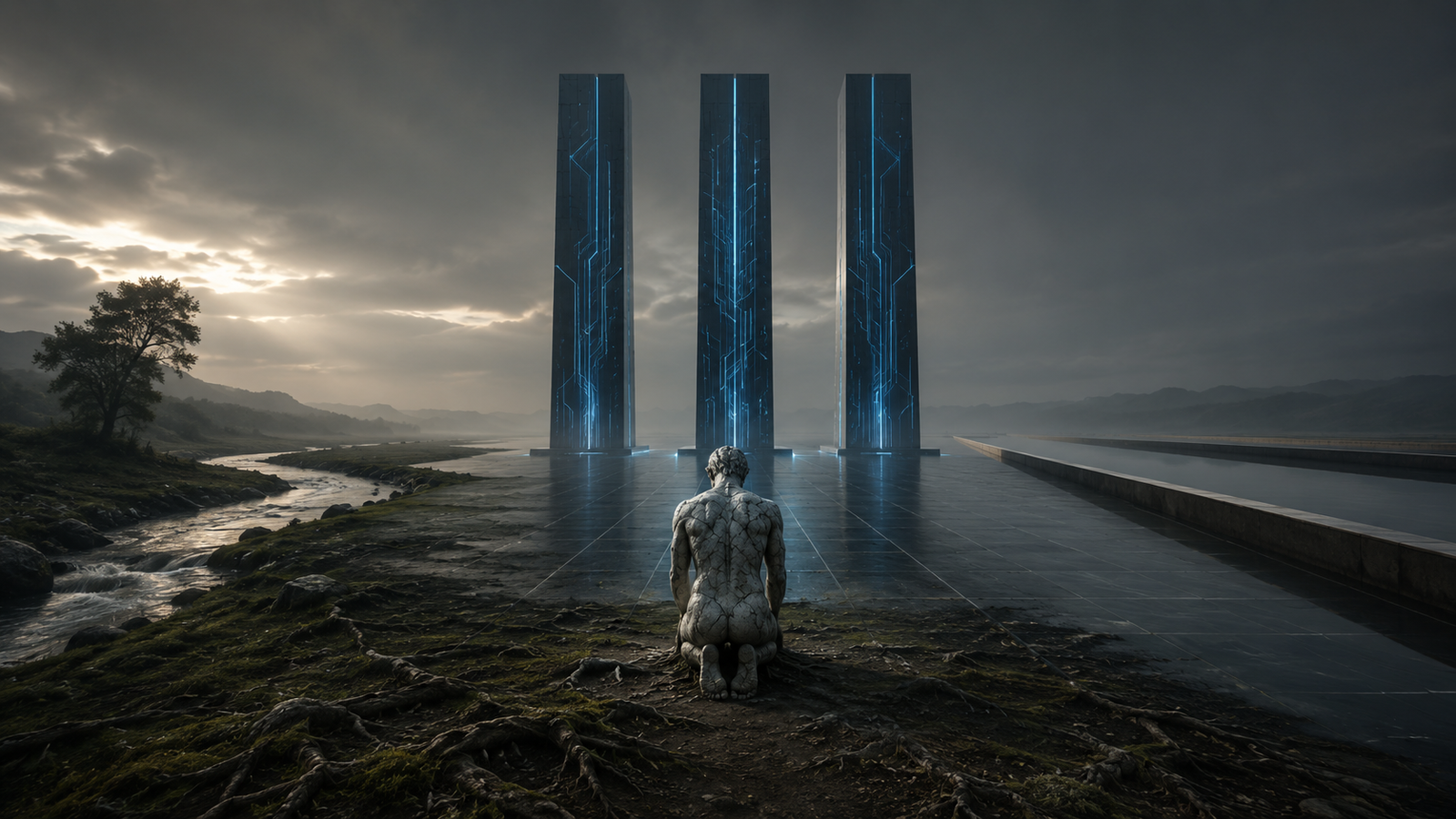
There’s a moment — hard to pin down exactly when it happens — when you stop walking toward something and start kneeling before it.
It’s not a dramatic gesture. It’s not an epiphany or a conversion. It’s more like what happens to a tree when its roots hit rock: it starts to grow in the only direction the substrate allows, and in time it no longer remembers that it could once have grown in another. The posture becomes nature. The rock becomes the horizon.
That is exactly how one ends up kneeling before the idols of augmentation.
In the previous post we explored modern angelism: that conviction that the body is a faulty draft, a technical problem awaiting the engineer’s hand. But a question kept hovering: where does that certainty come from? Why are we so sure that designing is better than receiving, that more is always better, that every limitation is a malfunction and every capacity a parameter to optimize?
The answer lies in three idols. They’re not statues of stone or forgotten gods. They are structures of thought that disguise themselves as evidence, as neutrality, as common sense. And that’s precisely what makes them dangerous: they don’t announce themselves as dogmas. They’re simply there, like the air, and without realizing it you’re already breathing through them alone.
Idol 1: The Designable as Inevitability
Imagine a river. For thousands of years it flows according to its nature: with meanders, pauses, overflows. One day an engineer arrives and says: “This can be optimized. We’ll straighten the channel, control the flow, make the water arrive exactly where we need it.”
That’s how the first idol works: the conviction that because we can design something, it must be designed.
Michael Sandel, in The Case Against Perfection, identified something crucial: when we elevate design to a moral imperative, we lose the capacity to experience our lives as a gift. The “given” — that substrate of reality we don’t choose — is what allows us to have a relationship of humility with existence. But the augmentationist mindset sees the given not as a gift, but as a faulty draft awaiting the engineer’s pen.
The problem is subtle but devastating: if everything is designable, then nothing has value in itself. A body is not a biological marvel, the product of millions of years of evolution; it’s a beta version of what it really could be. A mind is an operating system with bugs that needs patching. A human capacity is a feature that could be enhanced in the next release.
But here’s where the idol plays dirty: it’s not that design is bad. It’s that design is neutral, right? That brings us to the second idol.
Idol 2: Augmentation as Neutrality
This is the most dangerous one because it’s the one that least looks like an idol.
When we talk about “augmenting” human cognition with artificial intelligence, or “improving” our physical capacities with implants, we do so with a language that pretends to be neutral. We’re simply adding capacities. A plus, with no associated negative. What could be wrong with having more?
Jürgen Habermas saw it clearly in The Future of Human Nature: there’s no such thing as a “neutral intervention” in the body or the mind. Every modification implies a metaphysical bet about what is valuable, what is worth preserving and what should be transformed. When you augment a human being’s memory, you’re not simply adding a capacity; you’re saying that forgetting is a defect. That cognitive finitude is a problem. That the experience of not knowing something is something to be eliminated.
And with that, you’ve eliminated the possibility of wonder, of learning as transformation, of the vulnerability that makes us human.
The idol works like this: it convinces you that you’re doing simple arithmetic (more capacity = better life), when in reality you’re playing with the deep grammar of what it means to be human.
Heidegger called it Gestell — the configuration of reality as “resources” susceptible to optimization. In the Gestell, nothing has value in itself; everything is evaluated according to its usefulness and its potential for improvement. The sky isn’t beautiful; it’s a “reservoir of solar energy”. A river isn’t a place of contemplation; it’s a “hydroelectric generator in potential”. And we ourselves, inevitably, start to see ourselves the same way: reservoirs of unrealized potential, machines with bugs, systems awaiting an update.
Under the Gestell, augmentation isn’t an option; it’s the only rational way to relate to reality. And that, precisely, is what turns this idol into a trap.
Idol 3: Fusion without Remainder
The third idol is the most seductive because it promises the perfect synthesis: the union of the human and the machine, the biological mind and artificial power, the individual and the augmented collective.
“There will be no conflict,” they tell us. “We’ll be more ourselves, only better.”
But here’s the problem: every genuine synthesis implies a “remainder”, something that cannot be completely absorbed into the fusion. When a drop of water mixes with the ocean, something is lost. It’s not bad or good; it’s real.
In the fusion of the human mind with AI systems, that remainder is precisely what makes us human: the capacity to be wrong, to resist, to be surprised by our own limitations. If the AI is inside your cognition, optimizing it in real time, then that space of freedom disappears. Not because the AI is evil, but because the very logic of optimization is incompatible with freedom.
Sandel put it this way: when we do everything according to design, we give up the experience of things happening to us. And with that, we give up gratitude, humility, surprise, redemption — the feelings that require something to escape our control.
The promise of the third idol is that we can have it all: power and vulnerability, capacity and surprise, individuation and collective. But the reality of the Gestell suggests that this is a beautiful lie. What promises to be “fusion without remainder” is, deep down, capture with an invisible remainder.
The Pattern
Do you see the pattern? The first idol convinces you that everything can be designed. The second convinces you that everything must be designed. The third convinces you that you can design it without consequences.
Together, they spring the trap: not every synthesis is communion. Some are capture disguised as improvement.
In the next post we’ll explore the fourth idol — the one that closes the circuit — and the possibility that there’s a way out of this logic that isn’t simply rejecting technology, but learning to inhabit it differently.
Because the point isn’t to stop augmentation. It’s to understand that the body, the mind, life itself, are not problems awaiting a solution. They are mysteries awaiting wisdom.
Next post: The Genic Guidance — The Fourth Idol and the Way Out of the Labyrinth

Leave a Reply