
A long read on how generative AI is literally rewriting what we mean by knowledge management in a company. Spoiler: it’s no longer a repository, it’s an organism.
// 00TL;DR
If you only have two minutes, take this with you. If you have twenty-five, come down to the root system with me.
The three ideas that hold this post together
- The KMS market is going through its biggest move in 25 years. The traditional stack (Confluence, SharePoint, Notion) is being absorbed by a new AI-native layer (Glean, Sana, Hebbia, Dust) and by the copilots embedded in the big suites (M365 Copilot, Google Gemini, Atlassian Rovo). Analysts can’t agree on the size (from 13.7 B USD according to Mordor Intelligence to 23.2 B according to Fortune Business Insights in 2025), but they do agree on double-digit growth (11–26 % CAGR) through 2030–2034. There’s a storm, and it’s going to be a long one.
- Generative AI doesn’t “improve” the KMS: it changes its DNA. The unit is no longer the document, it’s the synthesized answer. The interface is no longer search, it’s conversation (and soon, the agent that executes for you). The traditional governance architecture —file-based permissions— breaks down and demands new layers: RAG, GraphRAG, agentic retrieval, context engineering.
- We’re crossing the threshold where corporate knowledge stops being an archive and starts behaving like a living organism: with a nervous system (the agents), a metabolism (the RAG pipelines), episodic memory (the ambient transcriptions) and a brand-new risk —the atrophy of human judgment when every answer arrives pre-chewed—.
// 01The KMS market landscape
1.1 Four generations, one same creature
The Knowledge Management System is one of those concepts that reinvents itself every decade without ever quite dying. Four recognizable generations, where each new one didn’t replace the previous —just like a new species doesn’t extinguish its ancestors, it pushes them into the understory—. What matters is understanding which layer dominates the strategic conversation at any given moment. And right now, without a doubt, it’s the fourth.
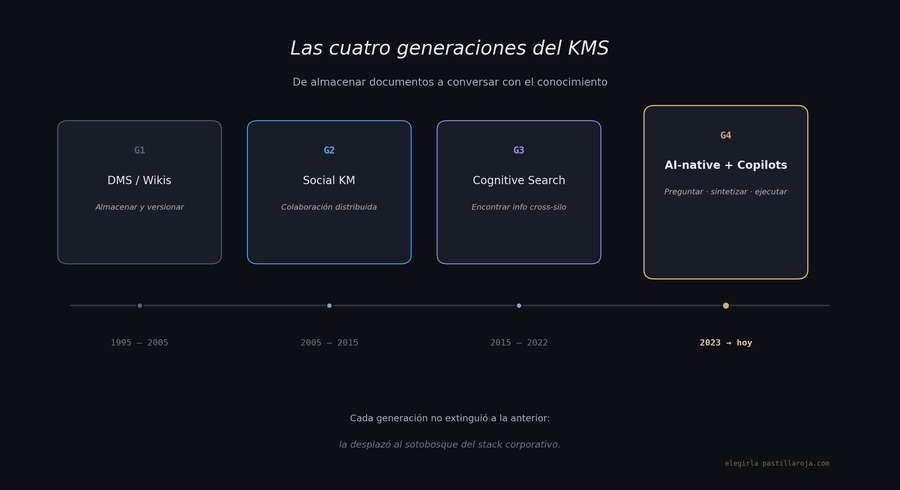
The fourth generation is not an incremental improvement, it’s a mutation: it changes the atomic unit of the KMS (from the document to the answer), the interaction model (from search to conversation, and from there to the agent) and the governance architecture (from static ACLs to real-time permission-aware retrieval). It’s like going from a dried-out herbarium to a garden that answers back when you water it.
1.2 Size and growth: a fog with a direction
Analysts can’t agree because each one draws the market boundary wherever it suits them. Even so, the 2025 figures give a sense of the magnitude:
| Source | 2025 size (USD) | Future | CAGR |
|---|---|---|---|
| Mordor Intelligence | 13.70 B | 37.64 B (2031) | 18.34 % |
| Fortune Business Insights | 23.2 B | 74.22 B (2034) | 13.8 % |
| Future Market Insights | 22.9 B | 81.9 B (2035) | 13.6 % |
| Market Research Future | 30.1 B | 97.73 B (2035) | 11.3 % |
| Straits Research | ~26 B | 59.51 B (2033) | 12.3 % |
| USDAnalytics | 40.1 B | 339.8 B (2034) | 26.8 % |
The figure that does deserve underlining: the intelligent chatbots and virtual agents segment grows at 21.88 % CAGR (Mordor), far faster than document management. Cloud deployment takes 62.18 %. The jungle is reorganizing fast.
And another data point from Menlo Ventures: GenAI infrastructure spend reached 18 B USD in 2025 (×2 vs. 2024). Within horizontal apps, copilots dominate: “Copilots dominate with 86 % share ($7.2 billion)”. Agent platforms capture another 750 M (Salesforce Agentforce, Writer, Glean).
1.3 Gartner and Forrester: the moment the analysts catch on
- Gartner declares that it does not publish a single Magic Quadrant for KM because “there are not enough common characteristics for a single market to exist”. KM appears embedded in four adjacent markets, and in Nov 2025 it launches the Emerging Market Quadrant for Generative AI Knowledge Management Apps, where Glean was named Emerging Leader.
- Forrester published for the first time The Forrester Wave™: Knowledge Management Solutions, Q4 2024 on Dec 2, 2024 — the first dedicated KM Wave in history. Leaders: Atlassian and KMS Lighthouse. Strong Performers: USU and SearchUnify.
Verbatim · Forrester, Jan 2025
«Knowledge management is changing before our eyes. The past decade has seen little advancement in knowledge management (KM) solutions, practices, or standards… With the introduction of generative and conversational AI, knowledge management is returning.»
1.4 Current taxonomy (2026)
Five layers coexist, don’t exclude each other, and overlap more and more: traditional KMS (Confluence, SharePoint, Notion), Enterprise/Cognitive Search (Glean, Coveo, Elastic), AI-native Knowledge Platforms (Glean, Sana, Hebbia, Dust, Writer), embedded Copilots (M365 Copilot, Google Gemini, Atlassian Rovo) and RAG/Vector/KG infrastructure (Pinecone, Weaviate, Databricks Vector Search, Azure AI Search, Neo4j).
Layers 1 and 4 are overlapping dangerously. If most knowledge already lives in M365/Google/Atlassian, why pay for Confluence + Glean + Notion AI + M365 Copilot all at once? The CIO answer in 2026 splits in two: (a) Microsoft-centric (Copilot + SharePoint Advanced Management + Purview); or (b) multi-suite with Glean (or Sana/Dust) as an agnostic overlay. SMBs lean towards (a); large enterprises towards (b).
1.5 Consolidation: when the big fish start swallowing
- ServiceNow → Moveworks (Mar 2025, 2.85 B USD): the most expensive move to date in KM/enterprise search.
- Databricks → Neon (May 2025, ~1 B) and Snowflake → Crunchy Data (Jun 2025, ~250 M): serverless Postgres for agentic workloads.
- Hebbia → FlashDocs (Jun 2025): closing the “last mile” of artifact generation.
- Accenture → Keepler (2025): Spanish data/AI boutique absorbed by a Big 4.
The battle for the knowledge worker is won at the control plane (governance, identity, agents, data), not in the wiki’s UI. Whoever keeps the central nervous system keeps the whole body.
// 02The impact of generative AI on KMS
2.1 From searching, to asking, to acting
McKinsey’s State of AI in 2025 (n=1,993) says: “88 % of organizations use AI in at least one business function, up from 78 % last year.” For the first time, knowledge management appears as one of the functions with the highest reported AI usage. But only 5.5 % of companies attribute >5 % of their EBIT to AI. The gap is one of workflow redesign, not technology. Buying the tool without rethinking how you work is like fitting a new lung into a body that keeps breathing through the same old nose: you won’t notice the difference.
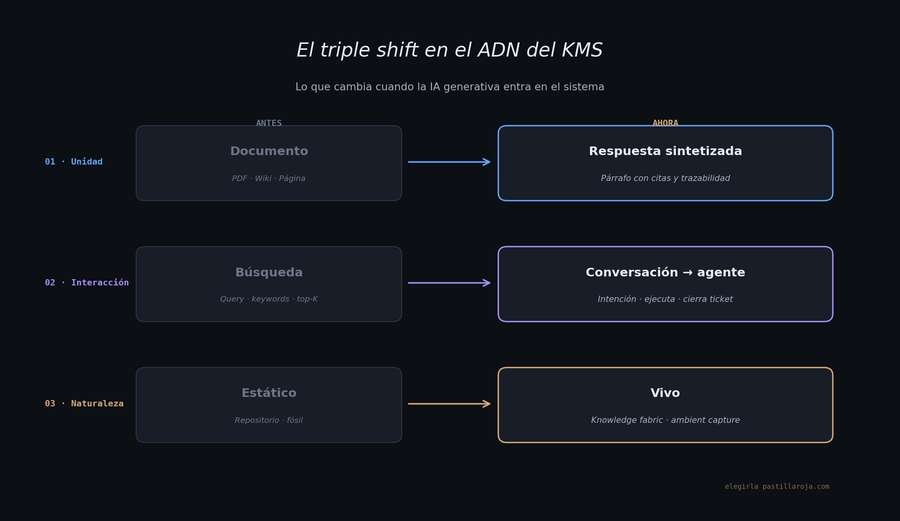
The shift is threefold: from documents to answers (the unit consumed stops being the PDF and becomes a synthesized paragraph with citations), from search to conversation to agent (the user states intentions; agents can execute) and from static to alive (knowledge is built in real time from Slack, transcribed meetings, CRM, code, tickets). It’s the difference between a fossil and a living being.
2.2 Emerging retrieval architectures
RAG baseline (2023): query → embedding → vector search → top-K → LLM. Hybrid + Reranking (2024): adds BM25 keyword and a cross-encoder reranker. GraphRAG (Microsoft Research, Feb 2024, open-source Jul 2024): builds a knowledge graph from text and enables hierarchical reasoning via community summaries. Costly indexing (up to 33K USD for large datasets); LazyGraphRAG (Nov 2024) cuts cost 10–90 % by deferring summaries to query time.
Agentic RAG (Singh et al., Jan 2025): supervisor agent + sub-agents (SQL, doc, KG) + reflective retry + synthesizer with audit trail. VentureBeat VB Pulse Q1 2026: hybrid retrieval adoption jumps from 10.3 % to 33.3 % in a single quarter.
Context Engineering / Knowledge Fabric (2026): a continuous semantic layer that joins structured + unstructured data + workflows + conversations. “The bottleneck is no longer the model, it’s the context.”
2.3 The critical challenges
- Hallucinations and traceability: the answer must come with citations to the source chunk. Whoever doesn’t cite, lies with confidence.
- Permission-aware retrieval: naive RAG destroys inherited permissions. Microsoft had to ship SAM, Purview DLP for Copilot, DSPM and consolidate it into the Copilot Control System. The “Echoleak” vuln (early 2025) demonstrated silent exfiltration via Copilot. If you feed everything to an agent, you also feed it your secrets.
- Knowledge decay: documentation expires. Modern KMS incorporate automated content pruning (18–26 % per year). Just as a healthy forest needs its leaf-litter cycle, a healthy knowledge base needs to die a little every year.
- Cost: GraphRAG indexing up to 33K USD; consumption pricing in Glean Protect Plus generates “CFO conversations” at renewal time.
- EU AI Act: most fall under limited risk (transparency). If it influences employment/credit/public-service decisions, it escalates to high-risk. The Omnibus of May 7, 2026 postponed the Annex III deadline to Dec 2, 2027. GPAI already in force since Aug 2025.
2.4 Knowledge Fabric: the organism’s connective tissue
Three frames converge: Data Fabric (Talend, Informatica, Atlan), Knowledge Graph + LLM (Neo4j, Stardog, Ontotext) and Knowledge Fabric (Teradata, Glean Enterprise Graph, Atlassian Teamwork Graph). It’s what gives agents their context.
Within 3 years, the Knowledge Fabric will displace the data lake as the most discussed architectural asset in IT investment committees. If the data lake was the liver (a metabolic store), the Knowledge Fabric is the central nervous system.
2.5 Embedded copilots: commoditization or new complexity?
M365 Copilot Business at 21 USD/user/month for SMBs <300 employees since Dec 2025 turns corporate search into a commodity within the M365 estuary. But it generates new complexity: over-permissioning, copilot proliferation (Sales, Service, Finance, Agent Builder, Copilot Studio) and Shadow AI: Harmonic Security identified 665 distinct GenAI tools inside companies after analyzing 22.4 M prompts; only 37 % of orgs have formal policies (IBM 2025). Microsoft responds with Agent 365 (GA 2026).
2.6 Metrics and ROI
Most orgs still measure vanity metrics. High performers redesign work around AI. That’s what correlates with real EBIT.
// 03The future of KMS in different contexts
3.1 Large corporations
Scale and heterogeneity (multiple ERPs, suites, accumulated M&A → chronic silos). Coexistence with data platforms: Databricks (Mosaic AI, Agent Bricks, Lakebase, Unity Catalog) and Snowflake (Cortex AISQL, Cortex Search, Snowflake Intelligence) become the knowledge backbone, not just the data backbone. Multi-jurisdiction and compliance (GDPR + AI Act + DORA, NIS2, MDR, HIPAA). Copilot proliferation risk: there are already orgs with 5–10 uncoordinated copilots.
The winning stack will combine: (1) a multi-vendor control plane (Agent 365 + Purview); (2) a Knowledge Fabric with graphs + vectors on Databricks/Snowflake; (3) vertical agent layers per function; (4) a reduced authoring/curation KMS (Confluence or Notion remain as the “single source of truth” but are no longer the main consumption UI).
3.2 SMBs
Access to enterprise capabilities via plug-and-play SaaS: Notion AI (10 USD/user), M365 Copilot Business (21 USD/user SMB), Guru AI, Glean for SMB. Barriers: unstructured and messy data, no “knowledge manager”, limited curation resources. Knowledge concierge opportunity: an external consultancy as the knowledge’s gamekeeper.
SMBs that arrived late to digitalization can skip generation G2 (wikis) and build straight on G4 (AI-native). It’s the old evolutionary trick of the adaptive leap: when you arrive late, you get to skip an entire era.
3.3 Flat organizations, startups, agile orgs
Traditional KMS has always had low adoption here: wikis fill up, get abandoned, and get relaunched. Much of the know-how lives in Slack, calls and Loom recordings. AI notetakers are the new infrastructure: Granola closed on Mar 25, 2026 a 125 M USD Series C led by Danny Rimer (Index Ventures) and Mamoon Hamid (Kleiner Perkins), raising its valuation to 1.5 B USD — a sixfold increase in less than a year. Slack/Teams/Discord embeddings (Glean, Coveo, Dust, Sana) turn past conversation into searchable knowledge.
“Corporate search” disappears as an interface: everything goes through ambient chat (Slack + AI assistant) and the “agent boss” (managing specialized agents like virtual interns). The document as artifact loses value; what matters is the recording + the agent that extracts the decision + the automatically created ticket. And here comes the dystopian note: when everything you say can be heard, transcribed, embedded and queried by an agent, when do you stop talking to your team and start talking for your own personnel file?
3.4 Cross-cutting 3–5 year predictions
- Search as the primary interface disappears in favor of conversational chat and proactive agents.
- KMS + Agent platform + iPaaS convergence: KMS stop being repositories and become orchestration platforms.
- Agent-readable knowledge: documents designed to be consumed by LLMs (structured, citable, versioned with quality embeddings).
- New roles: Knowledge Architect, Context Engineer, Agent Operator, Prompt Engineer. The classic Knowledge Manager morphs into “knowledge operations”.
- Anti-trend: a resurgence of human knowledge engineering. The better the agent, the more value hand-curated bases and expert-built knowledge graphs have. Hebbia is already hiring ex-bankers and ex-lawyers as forward-deployed engineers.
- The document bifurcates: legal/regulatory artifacts stay doc-centric with signature and versioning; “frozen conversations” replace the soft wikis.
// 04Strategic positioning
Reserved space. A positioning analysis of consulting services was meant to go here, but for now we’re leaving it fallow. We’ll pick it up in a future installment when I feel like opening that can of worms. If you got this far looking for the “commercial” part, sorry for the trap: the rest of the post is where the meat is.
// 05Conclusions
KMS are entering their fourth generation and, for the first time in the sector’s history, the change is not incremental but architectural: generative AI turns the document into an answer, the repository into a living knowledge fabric, and the knowledge worker into an “agent boss”. The commercial consequence is a fight for the control plane among three camps: productivity hyperscalers (Microsoft, Google, Atlassian), AI-native challengers (Glean, Sana, Dust, Hebbia, Writer) and data platforms (Databricks, Snowflake, ServiceNow).
And underneath all of that, a question that has been circling me for months now: when the company’s nervous system becomes a layer of agents that synthesize, remember and decide for us, what happens to the cognitive muscle of the people working inside? Just as an astronaut loses bone mass in zero gravity, a knowledge worker surrounded by pre-synthesized answers can lose structured thinking in just a few years. It’s not science fiction; it’s the workplace version of the same biomechanical principle.
// 06Open questions and caveats
- Does Microsoft Agent 365 + CCS become the de facto control plane, pushing Glean out of the enterprise? Indicator: Glean’s ARR over the next 4 quarters.
- Do GraphRAG vs. Agentic RAG vs. pure long-context stabilize, or do we stay in architectural churn? A decision made today may expire in 18 months.
- Does the EU adopt more AI Act Omnibus and does compliance pressure ease? If so, the compliance tailwind weakens.
- Dominant pricing in 2027 — seat, consumption or outcome-based? Critical for contract design.
- Does the human knowledge engineering anti-trend materialize? If so, it opens a premium service line (knowledge curators-as-a-service).
- What happens with transcribed meeting data in the EU? Otter, Granola, Fireflies open an “ambient surveillance” front that regulators haven’t addressed. Here the dystopia starts to smell real.
Caveats: sizing varies up to 10× between analysts; the Forrester Wave KM Q4 2024 figures are confirmed for Atlassian (Leader), KMS Lighthouse (Leader, “Top 3”), USU and SearchUnify (Strong Performers). The 3–5 year predictions are inherently speculative. Product roadmap mentions (Agent 365 GA 2026, etc.) should be revalidated quarterly.

Leave a Reply