
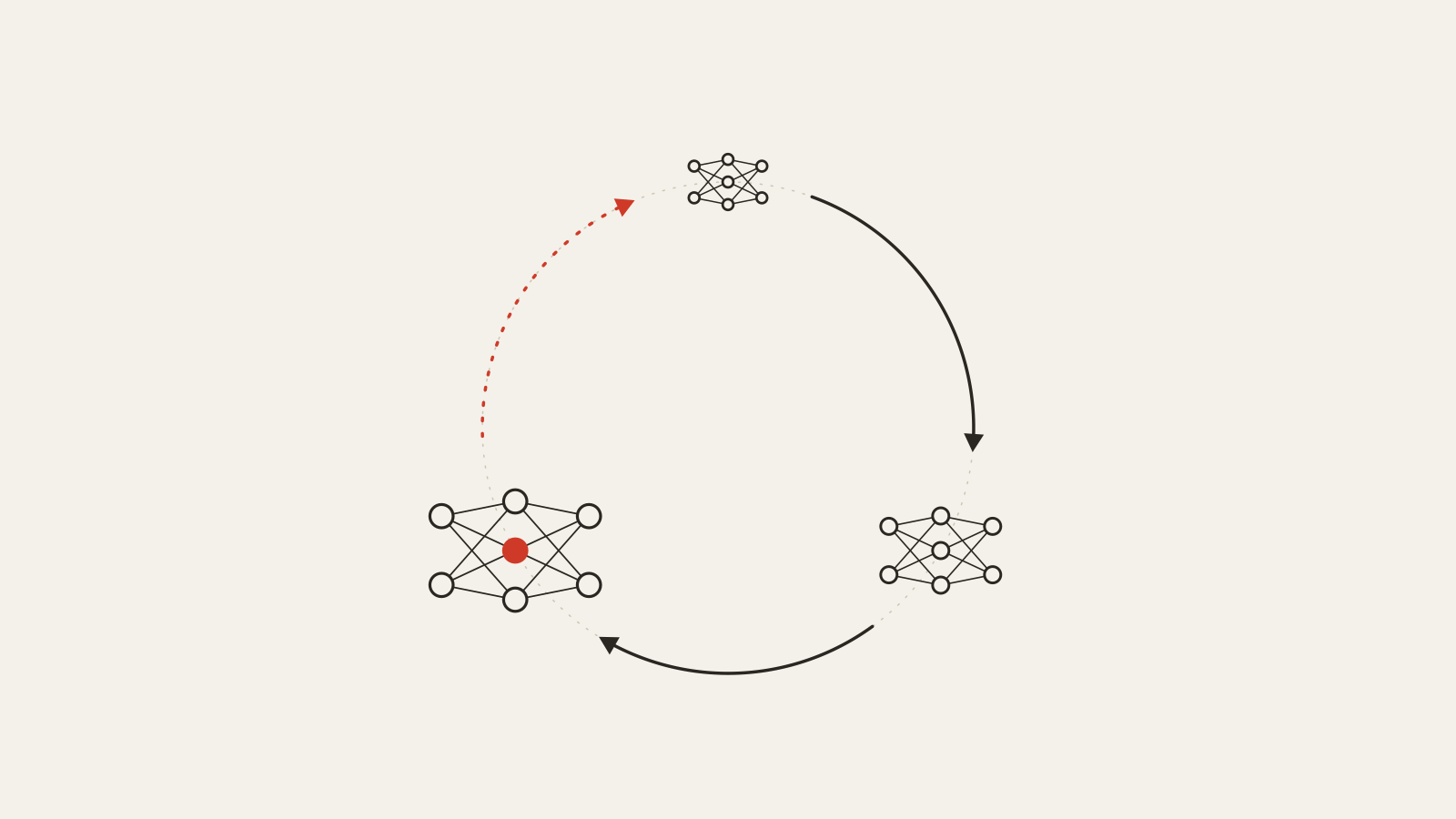
Evolution took almost four billion years to produce a species capable of reading its own DNA. And only a few more decades for that species to learn to edit it. Something similar — but compressed into months, not eons — is what the Anthropic Institute has just put on the table: their models already write most of the code used to build the next models. The snake isn’t biting its tail. It’s redesigning it.
What Anthropic Said (and Why It Matters)
The Anthropic Institute has published an essay titled When AI builds itself (by M. Favaro and J. Clark) about something our industry has spent years treating as polite science fiction: recursive self-improvement, or RSI. The idea that an AI participates in designing and training its successor, with each generation accelerating the next.
The interesting part isn’t the speculation — we have plenty of that. The interesting part is that this time they came with data from their own kitchen:
- More than 80% of the code lines merged into Anthropic’s repositories are written by Claude, not by a human.
- Each engineer merges 8 times more code per day than in 2024.
- Optimizing training experiments went from a 3× speedup a year ago to 52× with their latest internal models.
- On open-ended, poorly specified tasks — the genuinely hard ones — success jumped from 26% to 76% in six months.
Add the external evidence: according to METR, the time horizon of tasks a model can complete autonomously doubles every four months. Two years ago we were talking about minutes-long tasks. Today, full working days.
The essay is clear about one thing: the loop is not closed yet. No model has autonomously designed and trained its successor. But the stretch before that — AI writing, running and debugging the machinery used to manufacture the next AI — is no longer a hypothesis. It’s telemetry.
The Body That Remodels Its Own Skeleton
To understand what’s happening, a biomechanics metaphor helps me: bone.
The skeleton looks like the most static part of the body, but it’s living tissue in constant remodeling. Some cells tear down old bone (osteoclasts), others build new bone (osteoblasts). Every time you run, jump or lift weight, your skeleton rebuilds itself to better carry the load you’re asking of it. The body re-engineers itself, quietly, while you use it.
AI labs are arriving at something analogous. The model is no longer just the product: it’s part of the construction crew. Claude writes the code for the infrastructure where the next Claude will be trained. It optimizes the experiments that decide what that successor will be. It reviews the failures of the system that serves it. The skeleton remodels with every stride.
And here comes the nuance the essay itself underlines, which I think is the key to everything: this process has two very different planes.
The execution plane: writing the code, launching the experiment, producing the result. This, according to Anthropic, is essentially solved. The human cost of doing tends to zero.
The judgment plane: deciding which experiment is worth running, which problem to attack, when a promising result is actually a mirage. What researchers call taste. There, humans still win. For now.
It’s the difference between muscle and the central nervous system. Muscle executes, and the models already have superhuman musculature. But the decision about where to run still comes from a human brain. The essay’s uncomfortable question is: for how long? Their own data suggests that gap is narrowing too — and the authors admit, with unusual honesty, that they don’t know whether research taste is a real ceiling or simply «one more capability» that will fall like the others have.
Now, the Critical Reading (Because Here We Choose the Red Pill)
This blog isn’t called «Choose the Blue Pill», so let’s watch the magic trick from backstage.
First: the messenger is judge and party. Anthropic sells the agent that produces the acceleration Anthropic measures. The thesis «AI accelerates AI» happens to be the best possible marketing campaign for whoever sells that AI. This doesn’t invalidate the data, but it forces us to discount the narrative wrapping.
Second: many of the metrics are self-referential. The 76% success rate on open-ended tasks is determined by… a judge that is also Claude. The code-line figures are internal telemetry no outsider can audit. And the document itself admits that counting lines of code overestimates the real productivity gain. Credit to them for saying it — but let’s not forget it when quoting the 8×.
Third: the most spectacular figure is the weakest one. The essay reports that, at certain stuck moments, the model picks a better «next step» for a research project than the human does (64% of the time with their latest model). Sounds like checkmate. But those moments were selected precisely because the human had room for improvement. In the control set, where the human was already on a strong path, the model only improves things ~20% of the time. The headline lives in the fine print.
And fourth: end-to-end research still doesn’t transfer. In their most ambitious experiment, agents working 800 hours recovered 97% of a performance gap in a training problem, for about $18,000 — where a human team had recovered 23% in a week. Impressive. But the result failed when moved to production scale, and it was a human who chose the problem and defined how to measure success. The snake edits genes, yes — but it doesn’t yet decide what kind of organism it wants to be.
The Three Futures (and the One That Keeps Me Up at Night)
The essay sketches three scenarios, like three branches of a phylogenetic tree:
- The curve flattens. The exponentials turn out to be S-curves, like almost everything in nature. Research taste doesn’t emerge from scaling compute, and a genuinely new idea is needed. Even so, today’s capabilities diffuse through the whole economy and the world changes plenty. Anthropic includes this one almost out of courtesy: they don’t believe it.
- Compounding gains with humans at the helm. Development gets massively automated, but people keep setting direction and judging results. This is the lab’s central bet. Here an old engineering acquaintance shows up: Amdahl’s law — accelerate one part of a system and the bottleneck simply relocates. It already happened at Anthropic: generating code is so cheap that the limit is now reviewing it. The human as the bottleneck of their own creation.
- The loop closes. Systems design and train their successors, and the pace is set by available compute. Humans are left supervising a virtual laboratory that works at a speed they cannot follow. It’s the textbook dystopian scenario — not because the machines rebel, but because nobody, not even their creators, retains real visibility into what happens inside the loop.
My honest read: scenario 2 is the ground we’re already standing on, and scenario 3 has stopped being a campfire story. What worries me isn’t the Hollywood version. It’s something subtler and more biological: in nature, when a selection process starts feeding back on itself — runaway sexual selection, evolutionary arms races — the results are fast, strange and irreversible. Nobody designed the peacock’s tail. It emerged from the loop.
And What About the Rest of Us?
Three takeaways, even if you don’t train frontier models:
The bottleneck moves to verification. If generating code (or text, or analysis, or anything) tends toward zero cost, value gets scarce around those who know how to review, validate and judge. Invest in judgment. It’s the organ that takes longest to atrophy — but also the one you exercise least when the machine does everything.
Distrust the multipliers, keep the direction. The 8×, the 52×, the 76%: internal figures, unauditable, measured by the interested party itself. But the direction of the vector is corroborated by external benchmarks like METR or SWE-bench. The signal is real even if the volume is turned up.
Access to the loop is concentrating. If RSI compounds, it compounds as a function of compute. And compute sits in the hands of a handful of labs. That concentration — who has access to the self-improving machinery and who doesn’t — strikes me as the political question of the decade, far more urgent than any debate about conscious robots.
The snake already holds the gene editor. It still asks for permission… well, it still asks us for permission for every edit. The question Anthropic’s essay leaves floating between the lines, with admirable frankness, is what happens the day it stops needing to.
When that day comes, I hope we’re still around to write about it. Red pill firmly swallowed.

Leave a Reply